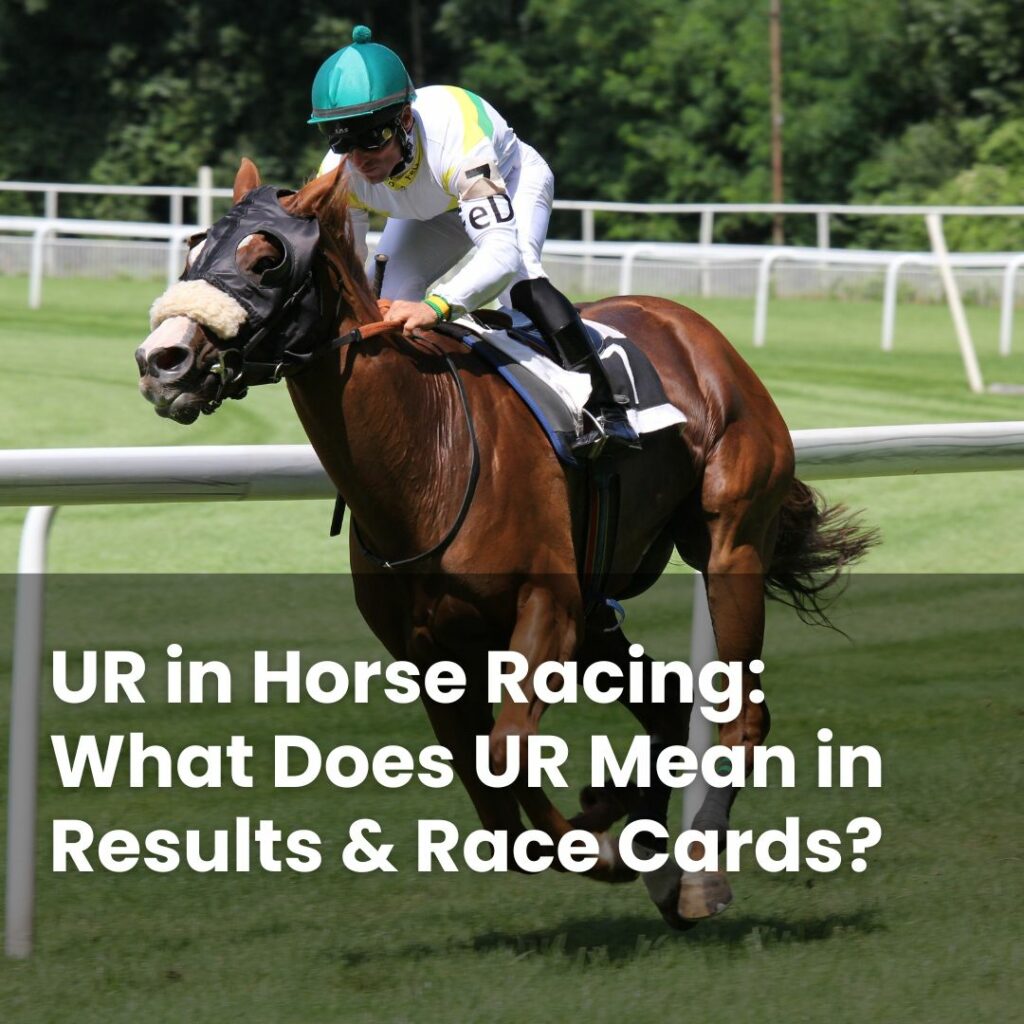
Horse racing uses a lot of shorthand, and “UR” is one you will often spot in results and race cards. It can look a bit cryptic at first, but it tells you something specific about what happened in a race.
This guide explains what “UR” stands for, where you will see it, what usually causes it, and how it affects betting settlement. It also sets “UR” alongside similar non-finish codes and shows how to read it in form guides.
If you choose to bet, use this information as context rather than a prediction and keep your play within sensible limits.
What Does UR Mean In Race Results?
In horse racing results, “UR” stands for “Unseated Rider”. It means the jockey came off the horse at some point during the race, so the horse did not complete the course and is recorded as a non-finisher.
You will see “UR” most often in jump races, where mistakes at hurdles or fences can unseat a jockey. It differs from “PU” (Pulled Up), where the jockey stops the horse, and “F” (Fell), where the horse goes down. With “UR”, the horse has not fallen, but the rider is no longer in the saddle.
Because a “UR” horse does not pass the post, it does not receive a finishing position. That single code neatly explains why there is no placing beside that runner’s name for the race in question. Now that you know what it means, the next step is spotting where it appears in a horse’s record.
Where Does UR Appear On A Race Card?
On a race card, “UR” appears in the line that shows a horse’s recent runs, usually a compact string of numbers and letters near the horse’s name. Each character marks either a finishing position or a specific incident in a previous race.
A typical string might look like: 3 4 UR 2 P. In this example, the horse finished third, then fourth, then unseated its rider, then finished second, and later was pulled up. Some cards add context in the comments, such as “UR 4 out” to show where it happened during the race.
Seeing “UR” in this line helps you quickly understand that the horse did not complete on that occasion, without needing to read the full race report. With that in mind, it helps to know what usually causes a rider to be unseated.
See Our Top-Rated Online Casinos
Find the best online casino bonuses, read reviews from real players & discover brand new casinos with our list of recommended sites
What Causes A UR In A Race?
A “UR” occurs when the rider becomes dislodged before the finish. In jump racing, the most common trigger is a jumping error. Landing steeply, clipping the top of a hurdle, or meeting a fence on a poor stride can all unbalance horse and rider. Crowded approaches to obstacles, where several runners converge, can also raise the chance of a jockey being unseated.
Other causes include a stumble on the flat between obstacles, a swerve to avoid another runner, or contact that shifts the rider’s weight. Tack problems such as a slipping saddle are rarer but do happen. While “UR” is associated mainly with National Hunt racing, it can appear on the Flat if a rider is unseated leaving the stalls or when a horse jinks early on.
Whatever the cause, “UR” tells you the horse did not complete the course. That status matters for the official placings and, in turn, for how bets are settled.
How Does UR Affect Official Finishing Positions?
A horse marked “UR” is classed as a non-finisher and is not given an official placing. Only runners that cross the line are included in the finishing order.
This matters for form records because it separates genuine finishes from incidents that stopped a horse from completing the race. It also has a direct impact on bet settlement, since most markets pay out on horses that finish within the required places and treat non-finishers differently.
With placings clarified, the natural follow-on is how bookmakers handle a selection that unseats its rider.
How Do Bookmakers Settle Bets When A Runner Is Marked UR?
If a selection is “UR”, bookmakers typically treat it as a non-finisher:
- Win singles are settled as losing bets.
- Each-way bets usually lose both parts, as the horse has neither won nor placed.
- Place-only markets and multiples rely on finishers, so the “UR” leg is normally a loser.
- Forecasts, tricasts, and similar bets are settled based on the official result among the finishers.
Some firms run faller or non-finisher concessions at certain meetings, but eligibility and terms vary and are time-limited. Always check the rules shown on your bet slip or the operator’s settlement terms, so you know how your specific market is handled.
UR Versus Other Non-Finish Codes
Horse racing uses different abbreviations to explain why a runner did not complete a race. Understanding the distinctions helps when reading a form line.
PU (Pulled Up)
“PU” means the jockey has decided to stop the horse during the race. Common reasons include tiredness, a loss of action, or concern about the horse’s welfare. The horse does not pass the post and is recorded as a non-finisher.
F (Fell)
“F” is used when a horse falls, typically at a jump. This often unseats the jockey and brings the horse to a halt. Welfare checks usually follow, and, as with other non-finish codes, the horse does not register a finishing position.
UR (Unseated Rider)
“UR” shows the jockey has come off, but the horse has not fallen. It is most often tied to a jumping error or mid-race incident that shifts the rider from the saddle.
How To Read UR In Form Guides And Commentaries
In a form guide, “UR” sits among a sequence of results. Numbers indicate finishing positions, while letters explain incidents. For example, a sequence like 2 UR 5 tells you the horse ran second, then unseated its rider next time, then finished fifth.
Short written comments usually add context, noting the stage or obstacle, such as “UR at fourth” or “UR when prominent two out”. These notes help you judge whether the incident was early, late, or at a key moment in the race.
If a “UR” appears alongside several clear rounds on similar ground or over similar obstacles, it may read as a one-off. If it clusters with other non-finishes, it can prompt a closer look at conditions, race pace, or jumping confidence discussed elsewhere in the horse’s profile.
What Are Common Misunderstandings About UR?
A frequent misconception is that “UR” means the horse fell. It does not. It only confirms the rider was unseated. That difference matters when comparing past runs that show “F” against those marked “UR”.
Another misunderstanding is that “UR” is the same as being “Pulled Up”. “PU” reflects a decision by the jockey to stop the horse; “UR” records an incident that separated horse and rider.
Some readers assume a horse that has unseated its rider will do so again. While patterns can be revealing, a single “UR” is not a forecast. Context such as ground, field size, course layout, and previous clear rounds often gives a better picture.
Finally, not all bookmakers settle every market the same way when a runner is “UR”. Core principles are similar, but terms and any concessions differ, so the small print still applies.
Practical Uses Of UR For Form Analysis
Seeing “UR” in a form line adds colour to a horse’s recent profile. It shows the horse did not complete because the rider came off, which invites a few practical checks. Was it early or late in the race? Did it happen at an open ditch, a downhill fence, or after a mistake when pace lifted? Was the ground testing, or was the field tightly packed at the obstacle?
Comparing “UR” with other non-finisher codes helps build a rounded view. A sequence that mixes clean completions with a single unseat suggests an isolated incident. Repeated non-finishes in similar conditions may point to a setup that does not play to the horse’s strengths. Trainer and jockey comments, where available, can also clarify whether changes were made afterwards, such as different tactics or equipment.
“UR” is one piece in the wider puzzle. It can guide expectations about completion, but it does not determine them. If you choose to bet, keep stakes within a set budget and use safer gambling tools where they help.
Understanding “UR” makes race records easier to read and helps you interpret what a past run really tells you. With the code decoded, form lines become clearer and decisions can be made with a little more confidence and care.