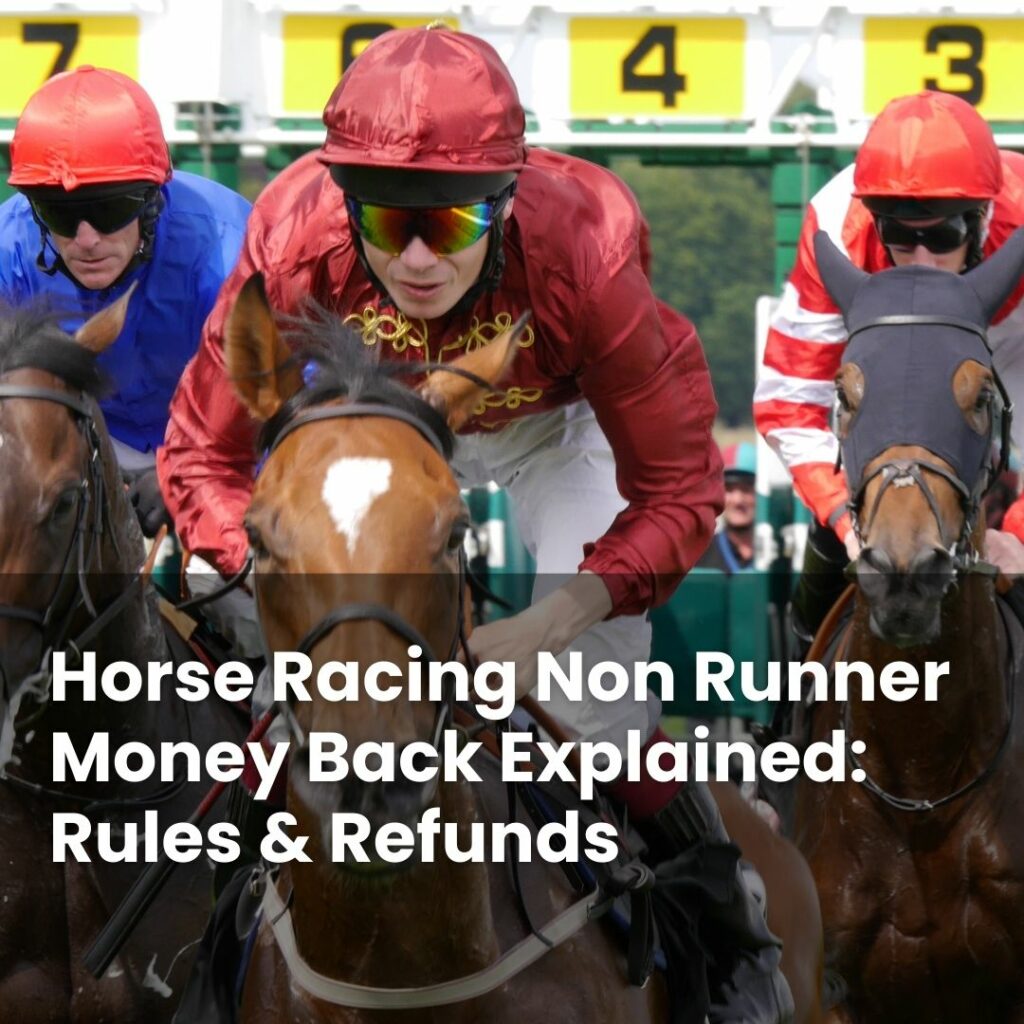
When betting on horse racing, you might notice special terms appear around big events. One you will often see is Non Runner Money Back. It is common, but many people are unsure how it actually works.
If you have ever placed a bet only to find your horse is not running, knowing what happens to your stake matters. It can prevent confusion on race day and help you avoid chasing answers at the last minute.
This guide explains what Non Runner Money Back means, why it exists, and how refunds are handled in everyday betting, with clear examples for UK customers.
What Does Non Runner Money Back Mean?
Non Runner Money Back is an offer that protects your stake if your horse does not take part. If your selection is withdrawn before the start and the offer applies to that race, the bookmaker returns your stake.
A horse becomes a non-runner when it is officially removed from the line-up, for example due to an issue at the start or a late decision from connections. If you used cash, the refund is cash. If you used a free bet, it is usually re-credited as a free bet.
This is not a universal rule. It is a promotional condition that bookmakers activate on selected races, most often in the run-up to major meetings. You will see it marked clearly on the race or market.
One important distinction is with ante-post markets, where you bet well before final declarations. Unless the Non Runner Money Back offer is stated at the time you bet, ante-post stakes are normally lost if the horse does not run.
When Is Money Refunded For A Non-Runner?
Money is refunded only when the bookmaker has confirmed that Non Runner Money Back applies to that race. If your horse is withdrawn before the off under those terms, the refund is processed automatically.
Timing varies by operator. Online refunds usually appear within a few hours, but can take up to one working day. Shop bets are refunded at the counter. If you used a promotional token, it is normally reissued rather than paid as cash.
It is worth checking your bet receipt or account history to confirm the settlement is correct. If something looks off, contact customer support with your bet reference so they can investigate.
Moving from the when to the who, different bookmakers handle these refunds in slightly different ways.
See Our Top-Rated Online Casinos
Find the best online casino bonuses, read reviews from real players & discover brand new casinos with our list of recommended sites
How Do Bookmakers Differ On Non-Runner Refunds?
Bookmakers decide when to activate Non Runner Money Back. Some offer it on selected feature races each week, while others reserve it for big festivals such as Cheltenham or the Grand National.
Processing can differ too. Most return cash to the original payment method, though free bets and bonuses are typically restored in the same format. Terms may also set cut-off times, for example from the day final declarations are published.
Ante-post markets are the key outlier. Unless Non Runner Money Back is clearly advertised at the time you place the bet, ante-post stakes are not refunded if the horse does not run.
Refund speed also varies, from near instant to the end of the working day. If you are betting in a shop, staff can explain any local rules that differ from the online site.
With that in mind, let us look at how individual bet types are settled when a horse comes out.
How Are Single Bets Settled When A Horse Is Scratched?
For a single bet, settlement depends on the market terms you accepted when you placed it.
If Non Runner Money Back applies, the stake is returned when your horse is declared a non-runner. That covers withdrawals on the day and in the build-up, provided the offer was live at the time you bet.
If the bet was ante-post and there was no Non Runner Money Back, the stake is lost if the horse does not run. That is the core difference between ante-post and day-of-race terms.
Most bookmakers update settlement automatically and show the status on your bet slip or account. If anything seems unclear, a quick check of the rules for that race will usually answer it.
Next up, here is how non-runners affect each-way and place terms.
How Are Each-Way And Place Bets Affected By Non-Runners?
An each-way bet is two bets in one, a win and a place. If your horse is a non-runner and Non Runner Money Back is in play, both parts are refunded in full.
Non-runners can change the number of places paid. Place terms are set by the number of horses that actually start, so if the field size drops, the places can reduce. For example, a handicap that was paying four places might revert to three if enough horses come out.
Place-only bets work in much the same way. If your selection does not run and the offer is active, you receive a refund.
Race pages usually show the places on offer and note how they may change if there are withdrawals, so it is worth a quick look before the off.
With that covered, what happens if a non-runner is part of a multiple or accumulator?
How Are Multiples And Accumulators Settled With Non-Runners?
In a multiple or accumulator, each selection is a separate leg within one overall bet. If one horse in your slip becomes a non-runner and Non Runner Money Back applies, that leg is treated as void and the bet rolls on with the remaining selections.
So a fourfold becomes a treble if one horse does not run. If two come out, it becomes a double, and so on. Your overall stake continues on the reduced bet, and settlement is adjusted automatically.
Your bet history will show any changes in real time. It is a handy way to keep track of what your multiple has become before the remaining races start.
Now for the more exact-order bets, forecasts and tricasts.
How Are Forecasts And Tricasts Handled If A Runner Is Withdrawn?
Forecasts require picking first and second, while tricasts require first, second and third in the correct order. If any named horse in a straight forecast or straight tricast is a non-runner, the bet is void and the stake for that bet is returned.
For combination forecasts or tricasts, only the parts that include the non-runner are voided. The remaining combinations without that horse still stand.
Dividends can be affected when runners come out because the pool of possible results changes. Bookmakers settle these bets under the official rules set by the racing authorities.
It is always worth checking your bet confirmation before the off so you know which parts of a combination still apply.
When Does A Withdrawal After The Off Affect Payouts?
A withdrawal after the off means something happens once the race starts, for example a horse refuses to race, is left in the stalls, or is pulled up immediately.
At that point, the bet is not treated as a non-runner. Stakes stand and settlement follows the official result. Each-way and place payouts may be influenced if the effective number of finishers changes, but there is no refund simply because a horse failed to take part fully after coming under starter’s orders.
If a race is voided after the start due to a false start or major incident, bookmakers follow the official decision, which usually means voiding affected bets.
If anything unusual happens just after the start, the Stewards’ Report will explain how the race has been classified and how that impacts settlement.
How Does Starting Price (SP) Interact With Non-Runner Rules?
Starting Price means your bet is settled at the odds recorded at the off. It does not change how non-runners are treated.
If your SP selection is withdrawn before the race and Non Runner Money Back applies, you receive a refund like any other qualifying bet. If the bet was ante-post without the offer, the stake is lost if the horse does not run, regardless of choosing SP.
When non-runners are declared close to the start, winning bets in the race may be subject to Rule 4 deductions. This is a standard scale that reduces returns to reflect a key horse coming out. The deduction depends on the withdrawn horse’s price at the time, with shorter-priced withdrawals leading to a larger pence-in-the-pound reduction. For example, if a 2 to 1 favourite is withdrawn near the off, a set deduction is applied to winning bets on the remaining runners.
So, SP or fixed odds, the same non-runner and Rule 4 principles apply.
What Exceptions Or Special Cases Affect Refunds?
There are a few notable exceptions.
Ante-post bets are the main one. If you backed a horse before final declarations and there was no Non Runner Money Back at the time, your stake is not returned if the horse does not run.
Abandoned or voided races are another. If a meeting is called off or a race is declared void, bookmakers generally refund all bets. If a race is only partially completed or results are amended, settlement follows the official decision.
Finally, if a horse comes under starter’s orders but fails to take part properly, most bookmakers treat it as having raced. In that case, the bet loses rather than being refunded.
If you feel affected by gambling or find it has become a concern, visit Begambleaware.org for confidential help and support.
How Can I Check Terms Or Challenge A Missing Refund?
If you think a refund is due but it has not appeared, first read the race and market terms on the bookmaker’s site. Look for Non Runner Money Back details, any cut-off times, and whether the market was ante-post or day of race.
Next, check your bet receipt or account history. It will show if a refund has already been issued or if a leg has been voided in a multiple. Notes usually appear beside each bet explaining any change of status.
If the terms indicate you should be refunded and nothing has arrived, contact customer support with your bet reference, the horse, and the race details. If you are not satisfied with the response, you can use the bookmaker’s Alternative Dispute Resolution provider, an independent service listed on their site.
Understanding when Non Runner Money Back applies means you always know where you stand, so your betting account reflects exactly what you expected when a horse does not go to post.