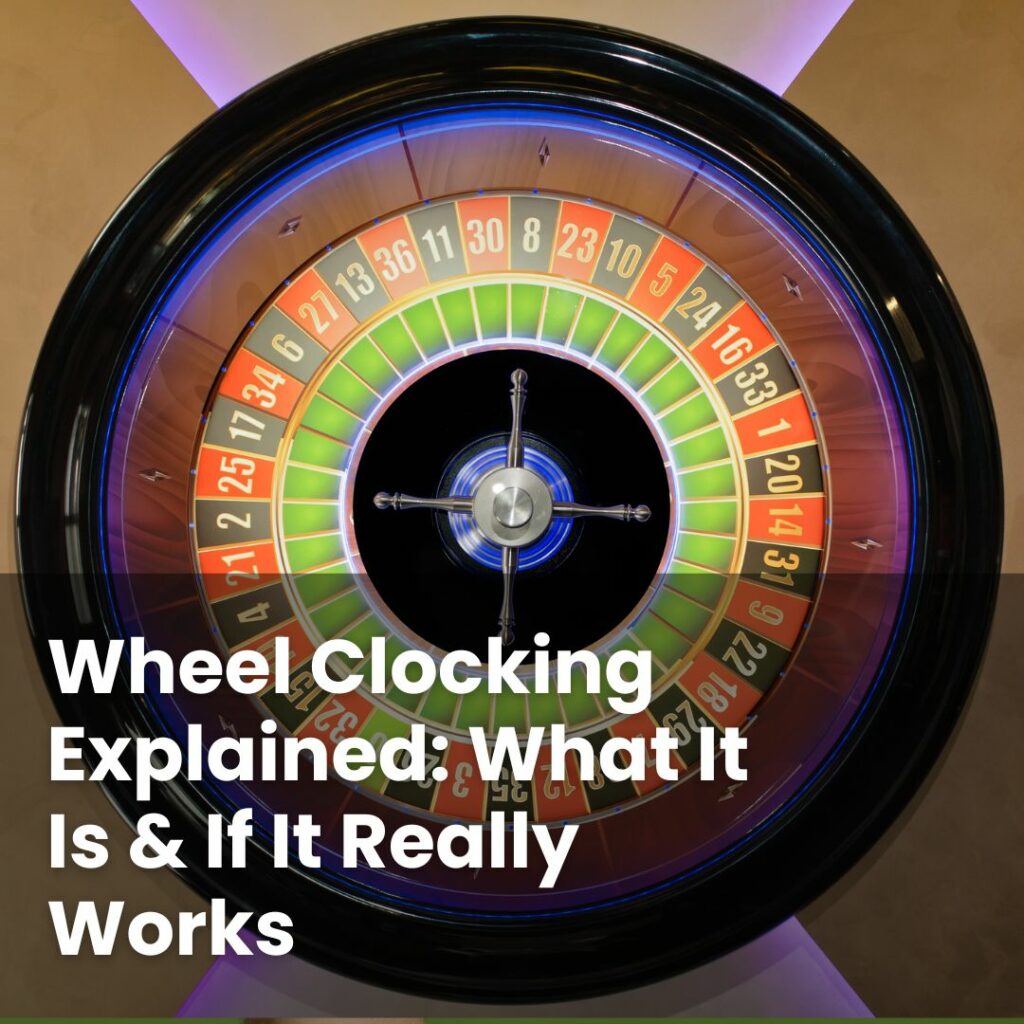
Some players believe they can spot patterns in roulette wheels and use these to their advantage. This technique is known as wheel clocking, and it has drawn interest for decades.
Understanding it means looking at how people try to detect bias, the kinds of data they gather, and how credible those findings really are. It also means knowing where the law stands in the UK.
Casinos are well aware of wheel clocking, so we will also look at how they respond, the common myths, and the practical limits anyone will face.
Read on to learn more.
What Is Wheel Clocking?
Wheel clocking is a method some players use to try to anticipate where the ball may land. They watch many spins, monitor how the ball and wheel move, and look for small patterns that might point to certain numbers or sections appearing more often.
The idea rests on the fact that no physical wheel is perfectly uniform. Tiny differences or wear could, in theory, tilt outcomes, though this is rare with modern equipment.
In practice, a player might record winning numbers, note where the ball drops relative to the wheel head, and estimate how quickly the ball and wheel are rotating. The hope is to turn those observations into predictions. It does not guarantee results, and any perceived pattern can fade as conditions change.
So how do players try to spot signs of bias in the first place?
How Do Players Detect A Biased Wheel?
Some players track a large number of results to see whether certain numbers or wheel segments produce wins more often than expected. They may jot down outcomes or discreetly note them on a device if house rules allow.
Others watch for visual cues. They look at how the ball hugs the track, when it drops, how it bounces across the frets, and whether particular areas seem to attract more finishes. They might also keep rough timings of the ball and the wheel to see if consistent speeds line up with certain landing zones.
Modern wheels are maintained and tested to reduce the chance of any bias taking hold, so apparent patterns often turn out to be coincidence rather than a true mechanical issue. That is where the type and quality of the data collected becomes important.
See Our Top-Rated Online Casinos
Find the best online casino bonuses, read reviews from real players & discover brand new casinos with our list of recommended sites
Types Of Wheel Bias Data
When players study a wheel, they often focus on four kinds of information.
Number frequency data involves tracking how often each number appears across many spins, then comparing the spread to what would be expected in the long run. A persistent outlier might look interesting, but short runs can be misleading.
Section or sector data groups adjacent numbers to see if any region of the wheel trends higher than the rest. This can help filter out noise from single-number variance.
Timing data compares the rotation speed of the wheel and the ball, with notes on when the ball tends to drop. The aim is to link consistent speeds with repeatable landing regions, although changes in spin strength, ball type, or wheel condition can quickly break these links.
Visual data logs where the ball first makes contact with the deflectors and how it bounces. Some players chart common bounce paths to see if they funnel results into particular pockets.
These approaches often overlap, but even well-kept logs can be swamped by normal variation. Which raises the next question: how reliable are the conclusions?
How Reliable Are Clocking Results?
Reliability is the core problem. Roulette spins are independent events, and the volume of data needed to show a genuine bias is much larger than most players collect. Short streaks happen naturally and can look convincing without signifying anything.
Human error adds another layer. Estimating speed by eye, missing a result, or misreading a chart can skew numbers. Two people observing the same table might record different details and reach different conclusions.
Most casinos use wheels built to tight specifications and service them frequently. If a fault does develop, routine checks typically catch it, and the wheel is repaired or replaced. That leaves little room for any consistent edge to persist.
Even detailed records cannot ensure a benefit. Results will vary, and no observation method can deliver consistent wins.
Even if someone believes their notes point to a pattern, the law still sets clear boundaries on how those notes may be gathered and used.
Is Wheel Clocking Legal In The UK?
Wheel clocking, in its basic form, involves observing and recording without using prohibited devices. In the UK, watching the game and taking notes by hand is not classed as cheating.
Using equipment to assist with predictions, such as electronic devices or concealed computers, is illegal under the Gambling Act 2005. Anyone caught using such tools may face legal action, and the casino can remove them from the premises.
Casinos also have their own house rules. Staff may intervene or ask a player to stop recording, and they can refuse service if they believe someone is attempting to exploit a perceived bias. Respecting both the law and venue policies is essential.
Casino Responses To Wheel Clocking
Casinos are proactive about table integrity. They monitor gameplay, analyse results, and maintain wheels to minimise the chance of any bias developing or going unnoticed. Staff are trained to recognise unusual behaviour and to respond quickly.
Regular cleaning, levelling, and component checks help ensure that each spin reflects the wheel’s intended performance. If a wheel shows irregularities, it can be rotated out for inspection or replacement.
How Do Casinos Detect Clocking Activity?
Surveillance teams use cameras and monitoring tools to observe tables and player behaviour. Signs that someone might be clocking include intensive note-taking, obvious timing of the ball or wheel, and coordinated tracking by a group. If staff see this, they may increase monitoring, speak with the player, or ask them to leave the table.
Alongside these measures, casinos keep maintenance logs, swap out components that show wear, and run fairness checks to help ensure outcomes remain unpredictable.
Common Misconceptions About Wheel Clocking
A frequent misconception is that anyone can use wheel clocking to gain a reliable advantage. In reality, modern equipment, active maintenance, and staff oversight make that outcome highly unlikely.
Another belief is that a short run of recorded results is enough to prove a bias. Meaningful analysis needs a lot of data collected under consistent conditions, and even then, natural variance can create patterns that appear convincing but are not.
Some assume casinos are unaware of wheel clocking or have no effective response. In practice, surveillance, training, and maintenance routines are designed precisely to spot and address it.
It is also sometimes thought that wheel clocking is always permitted. House rules and legal limits vary, and using any device to assist prediction is illegal in the UK.
Practical Limits And Risks For Players
Players considering wheel clocking face several practical hurdles. UK casinos inspect and maintain wheels regularly, so any mechanical bias is uncommon and usually short lived.
Collecting enough data takes time and access. Conditions also change. Different dealers, varied spin strengths, ball swaps, temperature shifts, or slight table movement can all alter how the ball behaves, undoing any patterns that seemed to appear earlier. Recording errors or selective note-taking can then push analysis in the wrong direction.
Casinos monitor for unusual activity. If staff suspect organised data collection or behaviour aimed at exploiting a perceived bias, a player may be asked to stop or to leave. Using devices to assist with predictions is against the law.
Most importantly, no strategy can guarantee a result, and losses are always possible. If you choose to play, set limits that fit your circumstances and keep betting occasional. If gambling starts to affect your well-being or finances, seek support early. Independent organisations such as GamCare and GambleAware offer free, confidential help.
Wheel clocking may be an interesting idea to read about, but in modern casinos it is rarely a practical route to an edge, and it should never shape how much or how often someone chooses to bet.