Understanding the different hands in blackjack is key to playing the game wisely. Some starting hands put you in a strong position, while others make life tougher against the dealer. Knowing how these hands are viewed helps with clearer decisions at the table.
In this blog post, you’ll find which hands are considered best and worst, what counts as a win, how soft and hard hands work, and why pairs and dealer rules can shift the value of the same total.
If you choose to play, keep it within your limits and remember that each round is uncertain.
What Counts As A Winning Blackjack Hand?
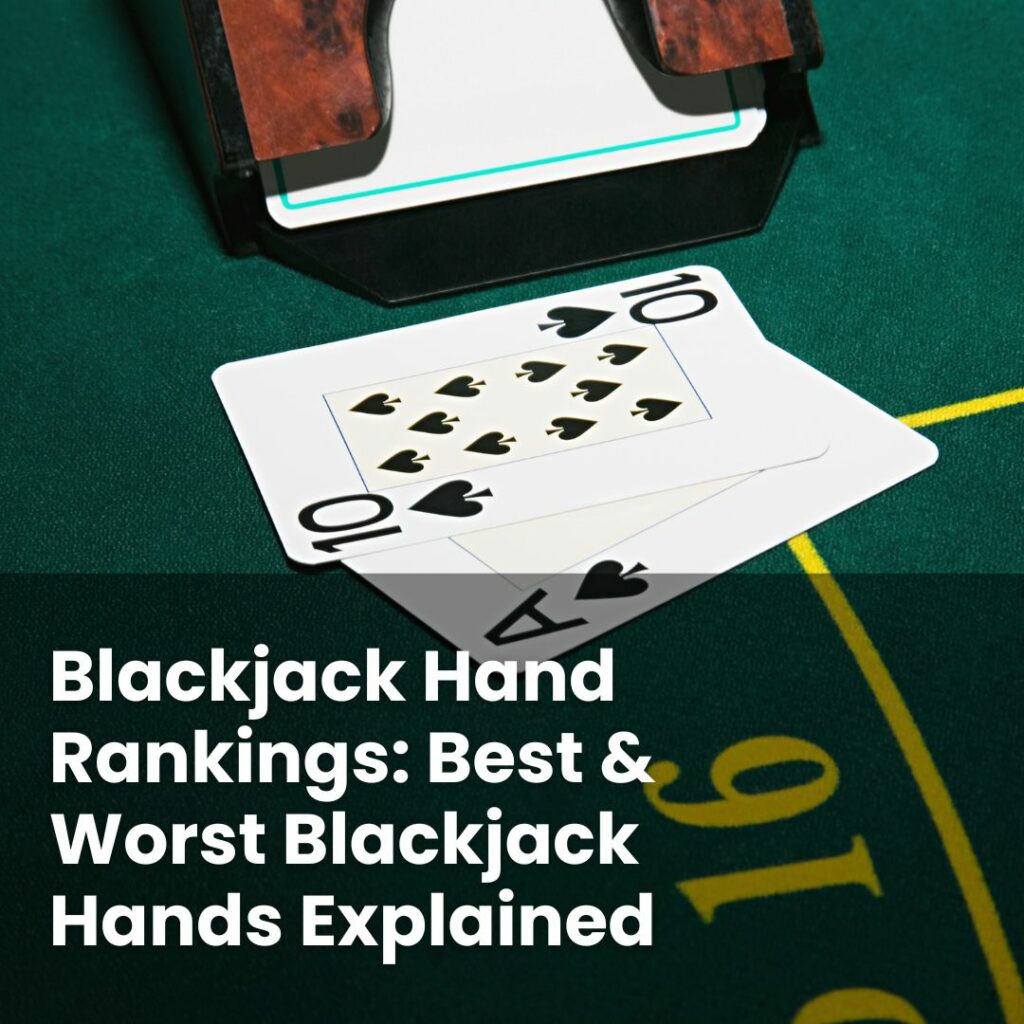
A winning blackjack hand is any hand that totals higher than the dealer’s without going over 21, or a natural blackjack. The most valuable outcome is an Ace with any ten-point card (10, Jack, Queen, King), as this settles the round immediately.
If your total is closer to 21 than the dealer’s, you win. If your total goes over 21, you bust and lose, even if the dealer later busts. When both have the same total, it is a push and your stake is usually returned according to the table rules.
Each round stands on its own. What happened last hand does not affect the next one.
Best Blackjack Hands Explained
The strongest outcome is a natural blackjack, covered in the next section. After that, two-card 20s such as 10 and Queen or two Kings rank highly because only 21 can beat them. Soft 20 (Ace and 9) is also powerful, combining a high total with flexibility if another card is drawn.
Totals of 19 are solid too, particularly when formed with high cards like 10 and 9 or Ace and 8. These hands do not guarantee a win, but they regularly put the dealer under pressure to reach 20 or 21.
See Our Top-Rated Online Casinos
Find the best online casino bonuses, read reviews from real players & discover brand new casinos with our list of recommended sites
What Is A Natural Blackjack And Why Does It Matter?
A natural blackjack is a two-card 21 made with an Ace and a ten-point card. It matters because it typically pays at a higher rate than other wins and is settled before further cards are drawn.
If both you and the dealer have a natural blackjack, the round is usually a push and your stake is returned under standard rules.
With that defined, the next question is how these hands are judged once the dealer completes their draw.
How Are Blackjack Hands Ranked Against The Dealer?
Your hand is only compared with the dealer’s, not with other players at the table. A hand ranks higher when its total is closer to 21 than the dealer’s. A bust is an automatic loss, regardless of what the dealer does next. If both totals match, it is a push.
Natural blackjacks outrank other 21s if the dealer does not also have one. For example, a two-card 21 beats a three-card 21. A player 20 will beat a dealer 18, lose to a dealer 21, and push against a dealer 20.
Those comparisons feel different when an Ace can shift value, which is where soft and hard hands come in.
What Are Soft Hands And How Do They Differ From Hard Hands?
Soft and hard hands describe whether an Ace can be valued at 11 without busting. This flexibility can change how a total plays out after another card is dealt.
How Aces Are Counted In Soft And Hard Hands
An Ace may count as 1 or 11. A soft hand contains an Ace counted as 11 and can drop to 1 if needed to avoid a bust. A hard hand either has no Ace or must count any Ace as 1, so its total is fixed.
Examples Of Soft Versus Hard Hands
Ace and 6 is a soft 17 because it can be 17 or 7. If a 9 is added, the Ace shifts to 1 for a total of 16. By contrast, 10 and 7 is a hard 17 and stays that way, however many cards follow unless it busts. An Ace and 8 can become a hard 19 if later cards make counting the Ace as 11 impossible.
Which Two-Card Hands Give The Highest Chance To Beat The Dealer?
The standout is a natural blackjack. Next come two-card totals of 20, such as 10 and King or two Queens, which are only beaten by 21. Ace and 9 is also a strong start because it yields a high total with the safety of an Ace that can adjust if another card arrives.
Not every opening is this comfortable, though, and a few starting totals are notoriously awkward.
Worst Blackjack Hands And Why They Lose
Hard 16 is widely viewed as one of the toughest totals. Standing often leaves you behind; taking another card risks a bust. Hard 15 has similar problems, as it struggles to beat common dealer outcomes.
Totals of 12 to 14 can also be awkward. They are not strong enough to stand confidently against many dealer hands, yet drawing carries the risk of pushing the total over 21.
Pairs of low or mid cards can be tricky too. Two 8s create a total of 16, and two 5s make 10, which changes how the hand might be played. Whether a pair improves the situation depends on the next cards and the table rules.
How Do Pairs And Splits Affect Hand Outcomes?
Being dealt two cards of the same value gives the option to split them into two hands. This creates a second wager for the new hand and changes the shape of the round. Splitting Aces, for instance, gives two fresh starting hands and is often limited to receiving one extra card on each Ace. By contrast, two 10-value cards total 20 already, so many players prefer to keep them together.
Splitting does not remove uncertainty. Each new hand must still face the dealer’s final total, and outcomes vary with the cards that follow. Rules also differ by table: some allow re-splitting, others restrict how split Aces are treated, and some permit doubling down after a split.
Hand strength matters, but so does what a win actually returns.
How Do Payouts Differ For Natural Blackjack Versus Other Wins?
Payouts depend on the result and the table’s paytable. A natural blackjack commonly pays 3:2, so a £10 wager would return £15 in winnings plus the £10 stake. Standard wins usually pay 1:1, returning the stake and an equal amount in winnings.
Always check the paytable. Some games pay 6:5 on a natural blackjack, which reduces potential returns over time.
How Do Dealer Rules Change The Value Of A Hand?
House rules shape how hands perform. One key rule is whether the dealer stands or hits on soft 17. If the dealer must hit soft 17, they draw more often, which can slightly reduce the player’s overall results.
The number of decks also influences outcomes. More decks generally make natural blackjacks a little less frequent and can affect how often certain totals appear. Other rules matter too, such as whether doubling after a split is allowed, how many times pairs can be re-split, or whether surrender is offered. These details change both risk and potential return for the same-looking hand.
Given all these moving parts, it is easy to see how a few myths take hold.
Common Misunderstandings About Blackjack Hand Strengths
A frequent misunderstanding is that certain hands always win or always lose. While some totals perform better on average, every outcome still depends on the dealer’s final hand and the specific rules in play.
Another assumption is that totals like 16 or 17 are comfortably strong. In reality, they can be awkward, with results shaped by the dealer’s upcard and draw. Similarly, any hand with an Ace is not automatically superior. Soft hands offer flexibility, but they can still be overtaken by the dealer.
Players sometimes believe splitting pairs guarantees a better result. It does not. Splitting changes the round and may help or hinder depending on the cards that follow and the table rules.
If you choose to play blackjack, set personal limits that fit your circumstances and take breaks to keep decisions clear. If gambling starts to affect your well-being or your finances, seek support early. Independent organisations such as GamCare and GambleAware offer free, confidential help for anyone who needs it.
Understanding where each hand stands, how rules affect results, and what different wins pay puts you in a stronger position to enjoy the game on your terms.