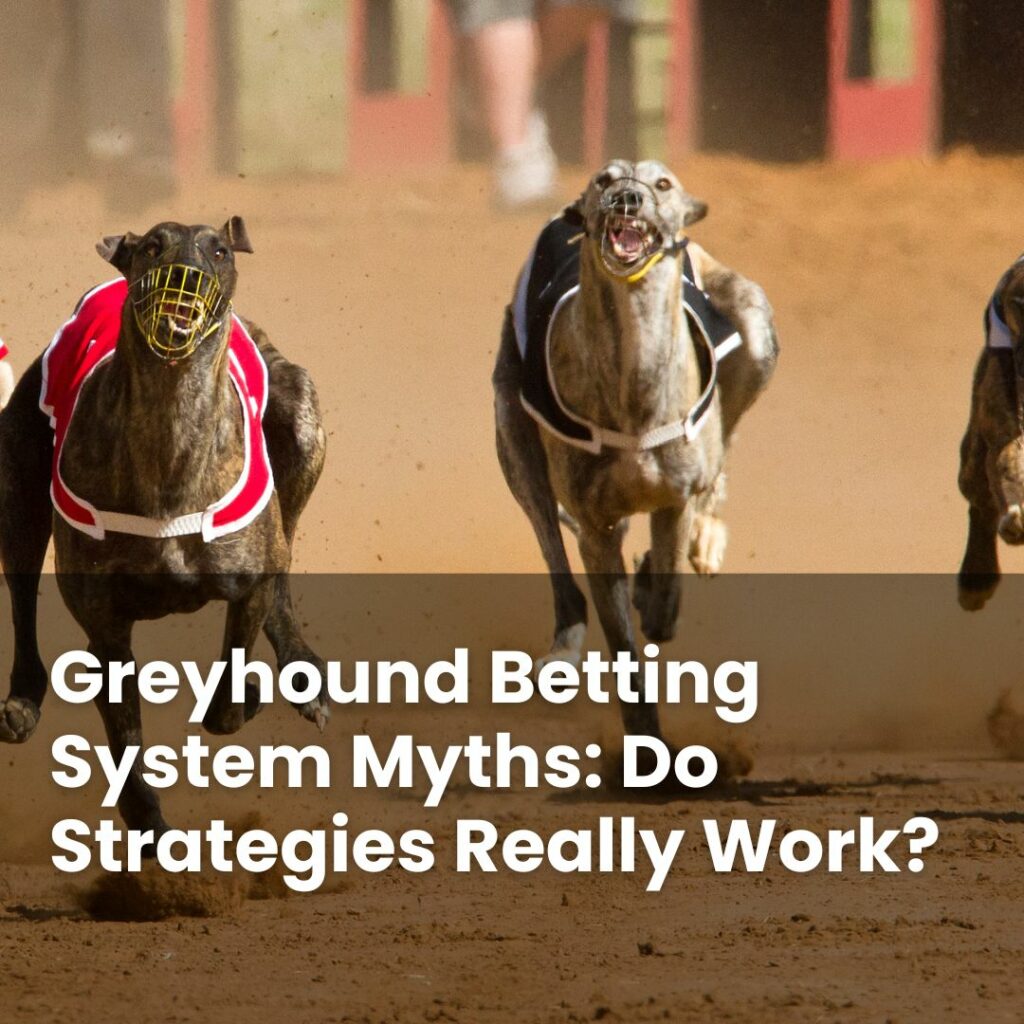
Greyhound racing has been part of British culture for decades, with fast sprints and tight finishes adding to the appeal. Alongside the action, there are plenty of so-called systems that promise a simple route to better results, often packaged as rules anyone can follow.
It’s easy to be drawn in by talk of tidy formulas and routines, especially if you’re getting to grips with how betting works. But can any approach really tilt the odds in your favour, or are these claims more folklore than fact?
Before putting money on the line, it helps to unpack what these systems involve and whether they stand up to real-world scrutiny. If betting ever stops feeling manageable or enjoyable, support is available through GamCare and BeGambleAware.
What Are The Most Common Greyhound Betting System Myths?
One well-known myth is the idea that “following the favourite” is all you need to do. This means always backing the dog with the shortest odds. It sounds straightforward, but favourites do not win every race, and the prices you see already reflect how the market and bookmakers rate each runner.
Another common claim is that dogs from a certain trap will reliably come out on top, such as always backing Trap 1. While starting position can influence how a race unfolds, it is only one piece of the picture. The dog’s running style, recent form, the going, and how cleanly they break all contribute to what happens over a few quick seconds.
You might also hear about the Martingale approach, which involves doubling your stake after a loss so that a later win covers earlier bets. This overlooks how rapidly stakes can grow and that bookmakers set maximum limits on bet sizes, which can cut the strategy short long before it recoups losses.
Another idea is that a dog is “due” a win after a series of near misses. Each race is a fresh event with its own dynamics; past placings do not create a built-in swing towards a first-place finish next time.
With those myths in mind, the next question many people turn to is not what to back, but how much to stake.
Do Staking Plans Produce Long-Term Profit?
A staking plan simply sets out how much to bet each time. Some keep the stake fixed, while others vary it based on what happened with the last bet. The appeal is obvious: a neat structure that feels more controlled than ad‑hoc decisions.
Plans that increase stakes after a loss, including doubling approaches, rely on the next win covering what came before. In reality, stakes can escalate quickly, hitting affordability and bookmaker limits. As mentioned earlier, limits exist to cap exposure, so a series may end before any recovery point arrives.
Crucially, staking plans do not change race outcomes or the probabilities behind them. Bookmakers price markets using performance data, trainer patterns, track characteristics and weight of money. Altering stake size does not alter that underlying picture.
If a staking plan cannot change probabilities, maybe the answer is simply to support the most likely winner each time. That leads to the next idea many punters consider: favourites.
See Our Top-Rated Online Casinos
Find the best online casino bonuses, read reviews from real players & discover brand new casinos with our list of recommended sites
Does Backing Favourites Always Beat The Market?
Backing the favourite means siding with the runner at the shortest price. Because that dog is rated most likely to win, it seems intuitive that doing this every time might produce steady gains.
In practice, you tend to see more winning bets than with random picks, but often at prices that do not cover the long-run strike rate once the bookmaker’s margin is included. You may have a run of winners and still find the total return falling short of the total staked.
Favourites can be a solid indicator of how a race is shaping up, but they are not a route to automatic profit. Prices are set to reflect perceived chance and to protect the bookmaker’s position over many races, which means a simple “always back the jolly” approach struggles to get ahead.
If picking the supposed front-runner is not a shortcut, attention often shifts to where a dog starts. Does the draw offer something more reliable?
Do Trap Draw Or Box Systems Work In Practice?
Trap-draw systems focus on the numbered starting boxes. The thinking is that certain positions, especially the inside rail, might offer a persistent advantage. There is some logic here: starting position can influence how a dog reaches the bend, whether it gets a clear run, and how it settles into its stride.
Even so, draw position has to be weighed alongside running style (railers versus wides), the sectionals of the field, the track’s layout and camber, and the calibre of opposition. Some tracks and distances can suit inside or outside runners more than others, and officials work to reduce any bias through maintenance and race planning.
Over time, a pure trap-based approach ignores too much of what decides races. Backing the same number again and again typically overlooks form, trainer intent and distance suitability. For those who want to dig deeper, attention often turns to the clock.
Can Formulas Based On Sectional Times Give An Edge?
Sectional times show how quickly a greyhound covers parts of a race, such as the break to the first bend or the run-in to the line. They can reveal useful traits: who breaks sharply, who sustains speed, and who finishes late. Used well, they help build a more rounded view than simple finishing positions.
Turning sectionals into a dependable formula is far from simple, though. Times can be affected by track condition, weather, interference, crowding at the bend, and the draw. Comparing runs across different grades and distances also needs careful normalising to avoid reading too much into one sharp figure.
Bookmakers and exchanges already factor split times and similar data into prices. Analysing them can make race reading more informed, but relying on isolated numbers rarely produces consistent gains on its own. And even when your read is sound, the price you take still matters, which brings us to margins and market movement.
How Bookmaker Margin And Odds Movement Affect Systems
Bookmaker margin, or overround, is the built-in edge created by pricing all runners so the implied probabilities add up to more than 100%. That cushion ensures the book returns a profit in the round. Even a small margin compounds over time, quietly pulling long-run results down compared to true chance.
Odds also move. Weather changes, non-runners, fresh information and weight of money all shift prices before the off. Markets adjust to balance exposure as much as to reflect new assessments. If a system relies on securing a specific price, slippage can quickly turn a bet that looked fair into something marginal.
On exchanges, headline margins can be lower but commission applies to winnings, and prices can thin out at the exact moment you want to place a bet. All of this means that any approach that depends on consistently capturing “value” has to grapple with timing and availability in a live market.
Given those hurdles, some bettors try flipping the idea entirely and look at laying instead of backing.
Do Lay Betting Methods Reduce Risk?
Lay betting on exchanges means offering odds for a dog not to win. Because most runners in a race do not finish first, this can feel safer at a glance. The key detail is liability: if you lay a dog at 4.0 for £10, your potential profit is the £10 backer’s stake minus commission if it loses, but your liability is £30 if it wins. One result going against you can outweigh several smaller successful lays.
Laying favourites at short prices reduces liability per bet, but it also trims potential return, and the occasional upset still has a meaningful impact. Commission on net winnings further narrows margins, so steady profits rely on disciplined pricing rather than the simple fact that “most selections lose”.
Across backing, staking plans, trap angles, sectional formulas and laying, the same theme runs through: no system removes uncertainty or the effect of margins. Informed analysis can make following the sport more engaging, but outcomes remain uncertain and money should only be risked in a way that feels manageable. If you ever want support, GamCare and BeGambleAware offer confidential help.