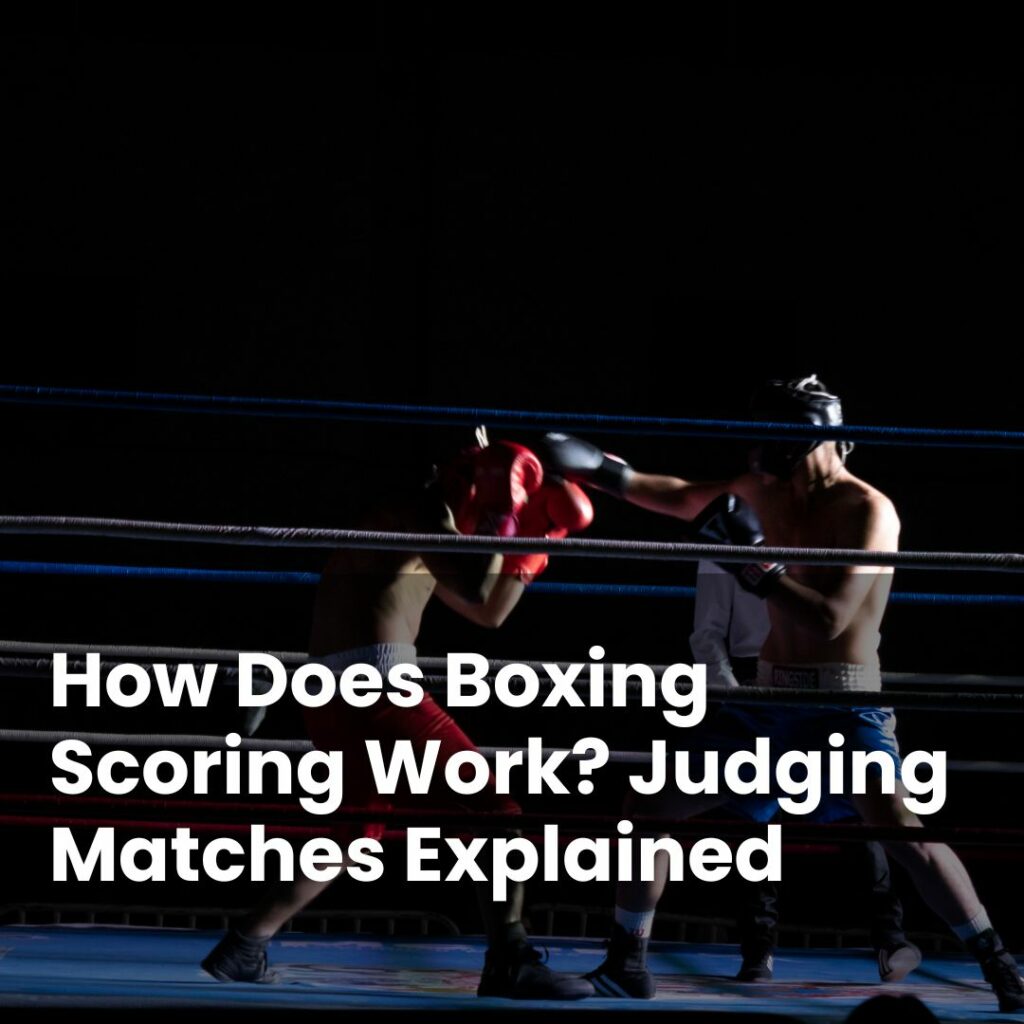
Ever watched a boxing match and wondered how the judges decide who wins each round? Close results and split scorecards can be confusing, especially when the action is fast and technical.
Scoring isn’t simply about the number of punches thrown; at professional events in the UK, there is a clear system that judges follow, with specific criteria that help to inform every decision.
If you want to learn how boxing matches are scored and how winners are decided, read on to discover the key factors judges look for in a round and the rules involved.
How Are Boxing Matches Scored?
In the UK, most professional bouts use the 10-point must system under regulation from the British Boxing Board of Control (BBBofC), in which judges must award at least one fighter 10 points in each round.
Three official judges score each round, awarding 10 points to the boxer they believe won, while the other boxer usually receives 9. If there is a knockdown or one boxer dominates, that round could be scored 10-8. On rare occasions, a completely even round may be marked 10-10.
Judges do not just count punches, as they assess quality over quantity, using agreed criteria to weigh who did the more effective work in that three-minute round. Some fights may finish early through a knockout, a technical knockout, or a disqualification. When a bout goes the distance, the judges’ round-by-round totals decide the winner.
Key Factors Judges Look For In Each Round
When judges score a round, they focus on a few core areas that show who had the advantage.
Clean punching: Judges value punches that land clearly with the knuckle part of the glove on the target areas. Short, sharp shots that land with precision score better than glancing blows or punches that catch arms and gloves. Body shots count just as much as head shots if they are clean and effective.
Effective aggression: Coming forward only helps if it results in meaningful success. The boxer who applies pressure with purpose, cuts off the ring, and turns that pressure into scoring punches is rewarded. Rushing in wildly or swinging without accuracy does little to impress the judges.
Ring generalship: The boxer who controls distance, sets the pace, and steers where the exchanges take place shows command, which can impact the judge’s scoring. Making the opponent fight at an uncomfortable range or rhythm is a sign of generalship.
Defence: Slipping, blocking, parrying, footwork, and head movement all reduce the opponent’s success, meaning a boxer who makes the other miss while landing their own clean shots may often win tight rounds.
These areas are weighed together, with clean, effective punching usually carrying the most influence when a round is close.
See Our Top-Rated Online Casinos
Find the best online casino bonuses, read reviews from real players & discover brand new casinos with our list of recommended sites
How The Ten Point Must System Works
In each round, the judge must award 10 points to the boxer they believe won the round, and a lower score to the other boxer, most commonly 9. A knockdown typically makes the round 10-8, and two knockdowns can potentially lead to 10-7. A 10-10 is rare and used only when the action is truly level.
A boxer might lose one round clearly but still be ahead overall by winning more rounds by small margins. After the final bell, each judge totals their own card. The result comes from those three independent tallies, which can produce outcomes such as a unanimous decision, a split decision, or a draw.
How Do Fouls And Point Deductions Work?
Rules are in place to keep bouts fair and safe. Fouls include actions such as hitting below the belt, head clashes, holding and hitting, punching after a break, or using the head or elbows.
Referees can issue a verbal warning, then a formal warning, and if the behaviour continues or the foul is serious, they may deduct a point. The referee signals the deduction clearly so the judges can mark it on their cards for that round.
Deductions can potentially change the outlook of a round. If a boxer did enough to win a round 10-9 but has a point taken off, it becomes 9-9. If they were losing the round 9-10 and a point is deducted, it becomes 8-10. Repeated or severe fouls can potentially lead to disqualification.
Why Do Judges Sometimes Disagree On Results?
Even with a shared rulebook, judges can reach different conclusions. Each one sits on a different side of the ring, so angles and sightlines vary. A shot that looks clean from one position might be obscured from another.
Judges also weigh the same criteria slightly differently in close rounds. One might favour cleaner single shots and tidy defence, while another may give more credit to sustained, purposeful pressure. In fast exchanges, not every touch is easy to see, and split-second moments can sway a close call.
That is why scorecards can differ and why split decisions or draws occur. Once you understand the criteria and how the 10-point must system is applied, those results make far more sense round by round, and following a fight becomes much more satisfying.