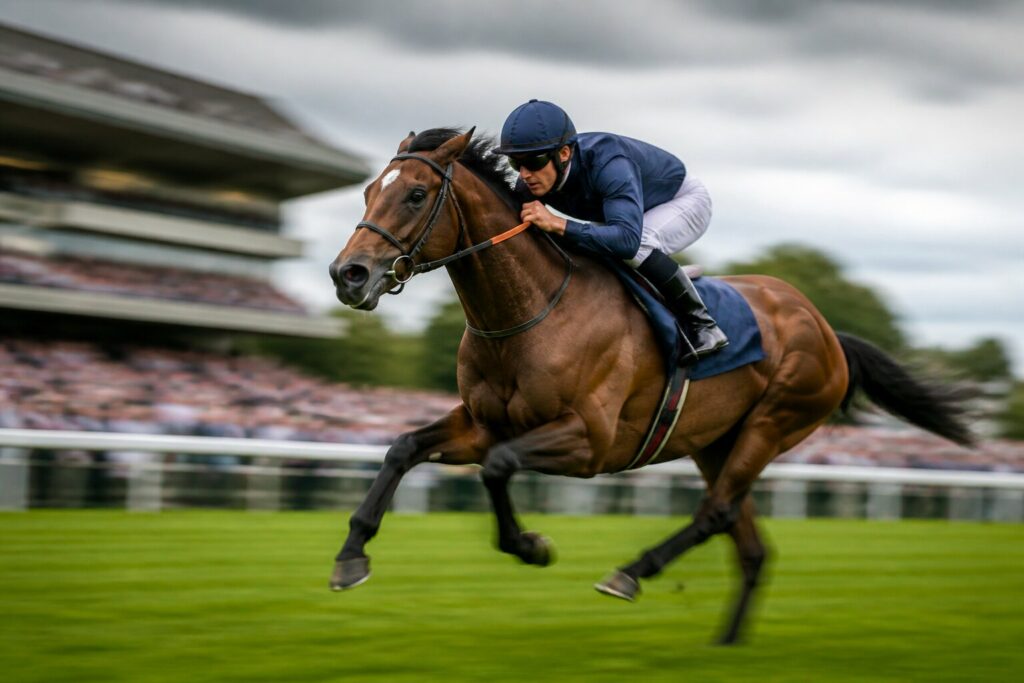
There’s nothing quite like the thundering hooves and sheer power of racehorses hurtling down the track. Whether you’re a racing fan or simply curious, one question stands out—just how fast can they go?
This article digs into the recorded highs, typical speeds by distance, how speed is measured and the factors that shape performance, with examples and context to help you understand what the numbers really mean.
What Is The Top Recorded Speed For A Racehorse?
The fastest officially recorded speed for a racehorse is 43.97 miles per hour (about 70.76 kilometres per hour). That mark was set by Winning Brew in 2008 over two furlongs at Penn National Race Course, and it represents a short, all-out burst rather than a sustained pace.
Most racehorses run slower than that headline figure. On British flat tracks, typical peak speeds are in the mid-30s to around 40 mph, depending on distance, ground and race tactics. It helps to think of the record as an extreme example of sprinting ability rather than a typical race outcome.
If you want to follow up on notable trainers, jockeys or famous races, you’ll find detailed comparisons elsewhere on the site.
Typical Racehorse Speeds By Race Distance
A horse’s speed varies with the type of race because training, breeding and tactics are tailored to different distances. Ground and weather also change how those numbers translate in practice, so the figures below are general guides rather than exact guarantees.
Sprint Race Speeds
Sprint races, usually 5 to 6 furlongs, encourage an all-out approach. Sprinters often reach around 38 to 40 mph when they hit full stride in short bursts.
These races tend to favour quick muscle power and sharp acceleration. Tactics are often aggressive from the start, with jockeys looking to secure a good early position and hold the pace for the short trip.
Middle Distance Race Speeds
Races around a mile to 1 mile 2 furlongs require a balance of speed and stamina. Horses in these events commonly average roughly 37 to 39 mph, managing pace so they can finish strongly.
Success over this range depends on a mix of attributes:
- sufficient cruising speed to stay in contention
- the stamina to maintain a high tempo
- tactical sense from the jockey to time the finishing effort
Staying Race Speeds
Longer events, such as 1 mile 4 furlongs and beyond, reward endurance. Average speeds typically drop to about 35 to 37 mph as horses run at a sustainable rhythm over a greater distance.
These races emphasise aerobic fitness and efficient energy use. Factors like race tempo, ground conditions and a horse’s staying pedigree make a big difference to the finishing speed over the closing stages.
These ranges give a practical sense of what to expect on race day and why some horses specialise at particular trip lengths.
See Our Top-Rated Online Casinos
Find the best online casino bonuses, read reviews from real players & discover brand new casinos with our list of recommended sites
How Is A Racehorse’s Speed Measured On The Track?
Measuring speed accurately has become more sophisticated, combining traditional timing with modern tracking to show not just finishing time but how a horse moved through a race.
Timing And GPS Systems
Electronic timing at the start and finish provides the basic race time, often supported by a photo-finish camera to confirm tight outcomes. Transponder chips attached to the saddlecloth or fitted into the horse’s equipment can give precise timing data for each runner.
GPS devices and on-course sensors record a horse’s speed and position moment by moment. Modern systems sample frequently enough to map a horse’s run through the race, so trainers and analysts can see where and when accelerations or decelerations occurred.
Trackside radar and high-speed cameras add extra detail, helping to verify GPS data and to correct for any signal gaps in enclosed parts of a course. Together, these technologies make it possible to see the precise point a horse reached its top velocity and how it sustained speed over different parts of the race.
Speed Figures And Sectional Times
Speed figures convert raw times into comparative ratings by adjusting for distance and track condition. These figures may also take account of the weight carried and the type of course when available, so numbers from different meetings can be compared more fairly.
Sectional times break races into segments—often by furlong—revealing which horses started fast, who faded and who finished strongly. Analysts use these split times to assess stamina, tactical speed and a horse’s ability to quicken in the closing stages.
These measurements are useful for analysing performance beyond the headline result, helping to spot patterns that suggest a horse’s strengths and likely suitability for future races. They can be used to:
- identify horses that perform best over particular distances or ground conditions,
- spot runners that are improving or regressing relative to previous efforts,
- assess race tactics, such as who prefers to lead or come from off the pace,
- provide additional context for trainers, owners and bettors without implying a guaranteed outcome.
Key Factors That Affect A Racehorse’s Top Speed
A number of biological and external factors combine to determine how fast a horse can run on a given day. Understanding these helps make sense of the numbers you see in form guides and race reports.
Breed And Conformation
Thoroughbreds dominate flat racing because their build suits high-speed galloping: long limbs, powerful hindquarters and an efficient stride. Subtle differences in bone structure, muscle attachment and hoof shape affect stride length and energy use, and so influence top speed.
Conformation faults, even minor ones, can limit efficiency or increase the risk of fatigue and injury. Assessing conformation gives a clearer idea of a horse’s natural speed potential, especially when combined with other factors such as age and prior performance.
Training And Fitness
Training shapes a horse’s physical make-up and conditioning. It influences:
- muscle development,
- cardiovascular fitness,
- recovery ability.
Different training programmes target different systems: some focus on explosive speed and fast-twitch muscle fibres, while others build endurance and aerobic capacity. Consistent, well-structured work is what allows a horse to reach and repeat high speeds, and planned rest and recovery are equally important to avoid overtraining.
Jockey Weight And Tactics
The total weight carried affects the effort required to maintain a given speed. Small changes in weight can alter how hard a horse must work, particularly over longer distances.
Jockeys influence not only the physical load but also the timing of efforts. Their decisions on when to press, sit off the pace or make a late move can change how speed is distributed through a race and how much energy remains for the finish.
Track Surface And Going
Turf softness or firmness alters traction and energy return. Firm ground generally allows quicker hoof rebound and faster times, while heavy going absorbs more energy and slows even the best athletes.
Other surface variables matter too: recent rain, mowing, and the underlying soil can all change how a horse handles the track. These factors often interact with hoof size and shoeing, so a surface that suits one horse may be disadvantageous to another.
Race Distance And Pace
A sprinter’s preparation and race plan differ from a stayer’s. For example:
- in sprints, horses can expend a higher proportion of their energy early and rely on raw speed,
- in longer races, careful pace management is critical to preserve stamina and produce a strong finishing effort.
How a race unfolds in terms of tempo and competition can therefore have a big impact on observed top speed. A fast early pace may produce quick sectional times but leave few horses with the stamina to sustain top speed to the line.
Each factor interacts with the others, so a top speed on paper is only part of the story when assessing a horse’s true ability.
Can A Racehorse Maintain Its Top Speed For A Whole Race?
Maintaining absolute top speed for an entire race is practically unheard of. Those peak velocities are short-lived bursts; most races involve phases where a horse settles into a rhythm, responds to rivals or lifts for a finishing run.
How a horse’s speed changes depends on distance, tactics and the state of the ground. A sprinter may sustain a very high pace for a short trip, while a middle-distance horse will trade some raw speed for the ability to keep going over a longer distance. Sectional data often reveals these patterns, showing whether a horse is more of a quick starter or a strong finisher.
How Does Top Speed Influence Betting And Odds?
Speed figures are one ingredient among many that affect odds. A strong top speed or a fast recent time can shorten a horse’s market price because it signals capability over part or all of the race distance. However, a single fast run does not guarantee repeat performance, so it should be weighed alongside other evidence.
Bookmakers and bettors also consider a range of additional factors when setting or taking odds, including:
- consistency of recent form
- course and distance record
- jockey bookings and rider experience
- ground preference and how the going might suit the runner
Using speed as one part of a broader assessment gives a clearer picture than relying on it alone. Comparing speed figures with the other items above can highlight horses that are improving, those that may be exposed by class, or runners that are simply best on a different type of surface.
If you’re exploring markets and comparing operators, focus on balanced information and clear limits for your activity. Bet responsibly by setting stakes you can afford to lose, taking regular breaks, and using tools such as deposit limits or self-exclusion if you need them.
How To Compare Racehorses’ Speeds When Reading Form Guides?
Form guides list times, speed ratings and sectional splits alongside other key details. Comparing speeds effectively means putting those numbers into context.
When you do that, consider factors such as:
- the race distance,
- the going on the day,
- the class of the race.
Also take account of weight carried, stall draw and whether a race was run at a strong or weak pace, since these can all affect raw times and ratings.
Look for repeat performances under similar conditions rather than relying on a single standout figure. Repeated similar speeds suggest a consistent level of ability, while one-off fast times can be due to unusually favourable circumstances.
Note whether a horse’s best runs come early, mid-race or in the closing stages. Sectional splits and race commentary will show if a horse tends to lead from the front, come through the field, or finish strongly, which helps predict how it might cope with different race scenarios next time out.
That context turns raw figures into a practical sense of how a horse is likely to perform on its next run.
Safety And Welfare Concerns Related To High Racing Speeds
High speeds raise safety considerations, and the sport implements multiple measures to reduce risk. Course inspections, veterinary checks, rules on equipment and ongoing review of race conditions all play a part in protecting horses and riders.
Veterinary teams and stewards monitor meetings closely, intervening when necessary, and trainers are expected to maintain high standards of care. Those systems aim to balance the performance aspects of racing with clear welfare priorities, and understanding them can deepen appreciation for the work that goes on behind every race.
Enjoy the sport with that awareness in mind, and take advantage of the available resources to learn more about horse care and race procedures.
**The information provided in this blog is intended for educational purposes and should not be construed as betting advice or a guarantee of success. Always gamble responsibly.