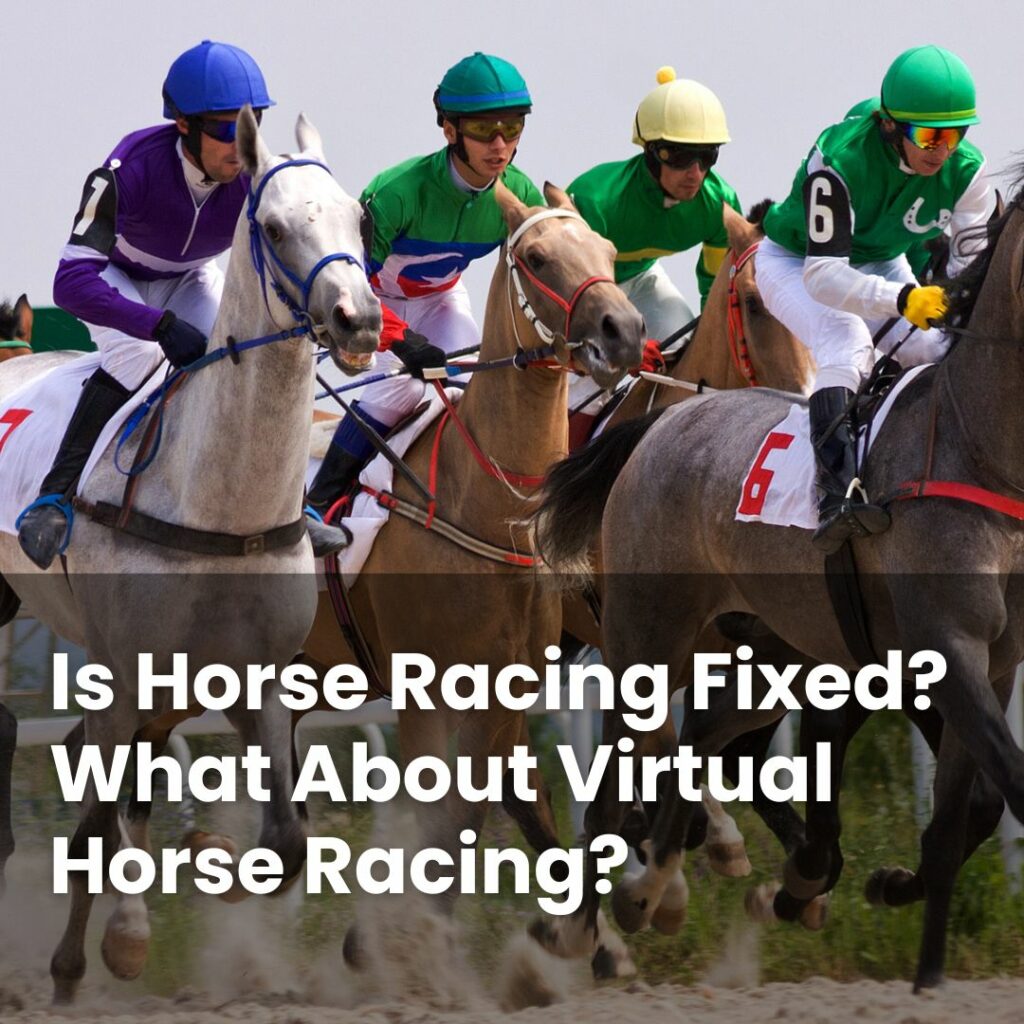
You might have heard rumours or seen debates online asking whether horse racing is fixed or open to interference. It is a fair question, especially when there is money at stake and strong emotions around big results.
With traditional racing drawing huge crowds and TV coverage, doubts sometimes arise about how closely the sport is monitored. Then there is the rise of virtual horse racing. Because these events are software driven, people often want to know how results are decided and whether they are truly random.
This article sets out what really happens behind the scenes in both forms of racing, how oversight works, and what that means for anyone following the sport. By the end, you will have a clear view of how races are run and what sets virtual racing apart.
Is Horse Racing Fixed In The UK?
When people ask if horse racing is fixed in the UK, they are usually wondering if results can be manipulated. In Britain, horse racing is overseen by the British Horseracing Authority (BHA), which sets rules for trainers, jockeys and owners, carries out investigations, and aims to keep the sport honest and safe.
From time to time there are isolated cases where someone tries to interfere with a result. These are taken very seriously. Sanctions can include bans, fines or criminal action, and the sport runs routine integrity checks such as dope testing and monitoring of betting markets.
Bookmakers also share information with regulators if they spot unusual betting patterns. Licensed operators must follow strict rules set by the UK Gambling Commission, which adds another layer of oversight to keep the system in check.
Most people in the sport want to compete fairly and win on merit. While no sport can claim to be entirely free of wrongdoing, British racing has structures in place to find problems quickly and deal with them.
If you are wondering what that looks like in practice, it helps to look at past cases.
What Evidence Exists Of Race Fixing?
Every now and then a news story will break about cheating in horse racing. These cases are uncommon, but they do happen. Examples include a jockey failing to ride to their true ability or someone passing on inside information that should have remained private.
Over the years, a small number of trainers and jockeys have been investigated and penalised after being found to have influenced results dishonestly. In some instances, police have been involved and prosecutions followed. When that happens, the penalties are designed to be strong enough to deter others from trying the same.
The BHA encourages confidential reports from anyone who spots something that does not look right. When irregular activity is flagged, such as a sudden dive or spike in odds or a performance that jars with what came before, officials take a closer look without delay.
These cases are rare against the backdrop of thousands of races each year, but they show that attempts to fix races have been detected and dealt with decisively. That leads to the obvious next question: how do regulators actually spot and tackle it?
See Our Top-Rated Online Casinos
Find the best online casino bonuses, read reviews from real players & discover brand new casinos with our list of recommended sites
How Do Regulators Detect And Punish Race Fixing?
In the UK, the BHA leads investigations into dishonest behaviour. Oversight runs from the parade ring to the betting ring, with officials checking how horses perform, monitoring market activity and ensuring participants follow the rules.
Technology plays a major role. Software tracks betting patterns from bookmakers and flags unusual activity. If a surge of money lands on a particular outcome without a clear public reason, analysts take note and investigate.
At the track, stewards watch every ride. If something looks out of the ordinary, they can start an inquiry straight away. That can involve reviewing footage, interviewing jockeys and trainers, and weighing up information from the public or industry sources.
When rule breaches are proven, the BHA can issue suspensions, heavy fines or permanent bans. In serious cases, matters are referred to the police and can lead to criminal proceedings.
All of this helps keep the sport fair. For those following the races, there are also a few signs that can hint at something that deserves a second look.
How To Spot Suspicious Patterns In Results Or Betting Markets?
Spotting unusual activity can be tricky, but a few signals are worth noting.
One is a sharp shift in odds shortly before the off with no public explanation. If a horse’s price shortens quickly and there is no obvious news to explain it, that can be a sign that information has spread privately. That said, market moves can also reflect late assessments from skilled analysts, so context matters.
Another is heavy betting on an outsider that then runs far better than expected. If there was no prior hint of improvement and no change in conditions to justify it, that pattern can raise eyebrows, especially if it happens repeatedly.
On the track, sequences can stand out too. A horse might run below par several times, then produce a big performance on a day when significant money arrived. Repeatedly questionable riding decisions by the same jockey can also draw scrutiny from stewards.
None of this proves wrongdoing on its own, but it explains why authorities and bookmakers watch for anomalies and investigate when needed. With that in mind, many people also ask how virtual racing compares.
What Is Virtual Horse Racing?
Virtual horse racing is a digital version of the sport shown through computer graphics. There are no live horses, jockeys or racecourses. Instead, the event is simulated on screen, complete with commentary and a broadcast-style presentation.
Each result is decided by a Random Number Generator (RNG), a mathematical system that selects outcomes in a way that cannot be predicted from the outside. That means no one knows the result until the race is complete. Virtual racing runs around the clock, usually with events every few minutes, so there is little waiting between races.
Odds in virtual events reflect the software’s weighting of each runner’s chances rather than real form or weather. You are watching a simulation, not a real stable’s past performances. Naturally, that leads to a follow-up question about fairness.
Can Virtual Horse Racing Be Fixed?
Virtual racing works differently from live racing because an RNG decides the result. Before operators can offer it in Britain, the software must be tested by independent laboratories to show it produces outcomes that meet strict fairness standards.
Because the outcome is drawn by the RNG, operators do not control which individual horse wins once the race is underway. Systems used by licensed providers are required to meet the UK Gambling Commission’s technical standards, and platforms are subject to regular checks to confirm that their RNGs are functioning as they should.
Any company offering virtual racing in the UK must hold a valid licence and comply with rules on transparency and player protection. Failing to meet those standards can result in sanctions, including the loss of the licence.
If you want to know how providers prove this in detail, the testing process is key.
How Virtual Racing Providers Ensure Fairness
How Algorithms And RNGs Are Tested And Audited
Virtual racing providers rely on Random Number Generators to decide results. An RNG is software that selects outcomes in a way that cannot be predicted or steered by the operator, which prevents outside influence over individual races.
To make sure these systems are genuinely random, every RNG used by a licensed UK provider must be independently tested against standards set by the UK Gambling Commission. Agencies such as eCOGRA, GLI and iTech Labs review the code, run statistical tests and verify that the results are not biased.
It does not stop at launch. Once a platform is live, regular audits are required. These reviews examine game data over time to confirm results remain random and within expected ranges. Where issues are found, games cannot legally be offered until they are corrected, and providers that breach requirements can face serious penalties, including the loss of their licence.
With the mechanics covered, it is useful to compare how real and virtual racing feel from a bettor’s point of view.
What Differences Matter For Bettors Between Real And Virtual Racing?
If you like to place a bet, the experience differs in a few important ways.
In traditional racing, live horses, jockeys and a real track introduce many variables. You can study recent form, trainer records and conditions on the day, then weigh everything up before the start. Late developments, such as a horse getting unsettled in the paddock, can matter.
Virtual horse racing is a software simulation. Weather, late withdrawals and real-world stables do not enter the picture. An RNG selects the result, and each runner’s odds are based on the model behind the scenes rather than real-life form or insider knowledge.
Timing is different too. Virtual races run every few minutes, day and night. Real meetings follow set schedules and can be delayed or cancelled for safety or weather reasons.
Odds also behave differently. In live racing, prices can move right up to the start as information and opinions flow through the market. In virtual racing, odds reflect the provider’s model and are not reacting to real-world news.
If you are unsure about your gambling or want support, contact BeGambleAware or the National Gambling Helpline for free, confidential advice. Taken together, the picture is clear: real racing relies on human competition under strong regulation, while virtual racing uses tested software and audits to deliver outcomes that meet strict fairness standards, so you can follow either format with a better understanding of how each one works.