Darts comes with a few terms that might puzzle newcomers, and “treble” versus “triple” is a classic example. At first glance, they seem interchangeable, yet in darts, they point toward different ideas.
Understanding this distinction can help make the flow of any match feel clearer, whether you are watching with friends or stepping up to the oche yourself. It can also help make scoreboards and commentary easier to follow, even before digging further into finer details.
This blog post explains each term, shows how the mix-up arises, and highlights why the specific area connected to one of these terms plays a major role in building strong scoring phases.
Why Understanding Treble and Triple Matters in Darts
Precise language helps everything fall into place during a match. Even a loose grasp of the difference might make totals easier to follow and clarify why a thrower might shift focus mid-turn. At this early stage, it is enough to know that one word refers to something physically marked on the board, while the other is more of a general idea connected to multiplying numbers.
This clarity appears in typical match moments. For instance, hearing a caller announce something like “Tops” (double 20) or “T20” signals specific intentions. If you already have a broad sense that treble points toward a particular zone, the rest becomes clearer.
In the next section, we look more closely at what that named area actually covers.
How Is a Treble Different From a Triple in Darts?
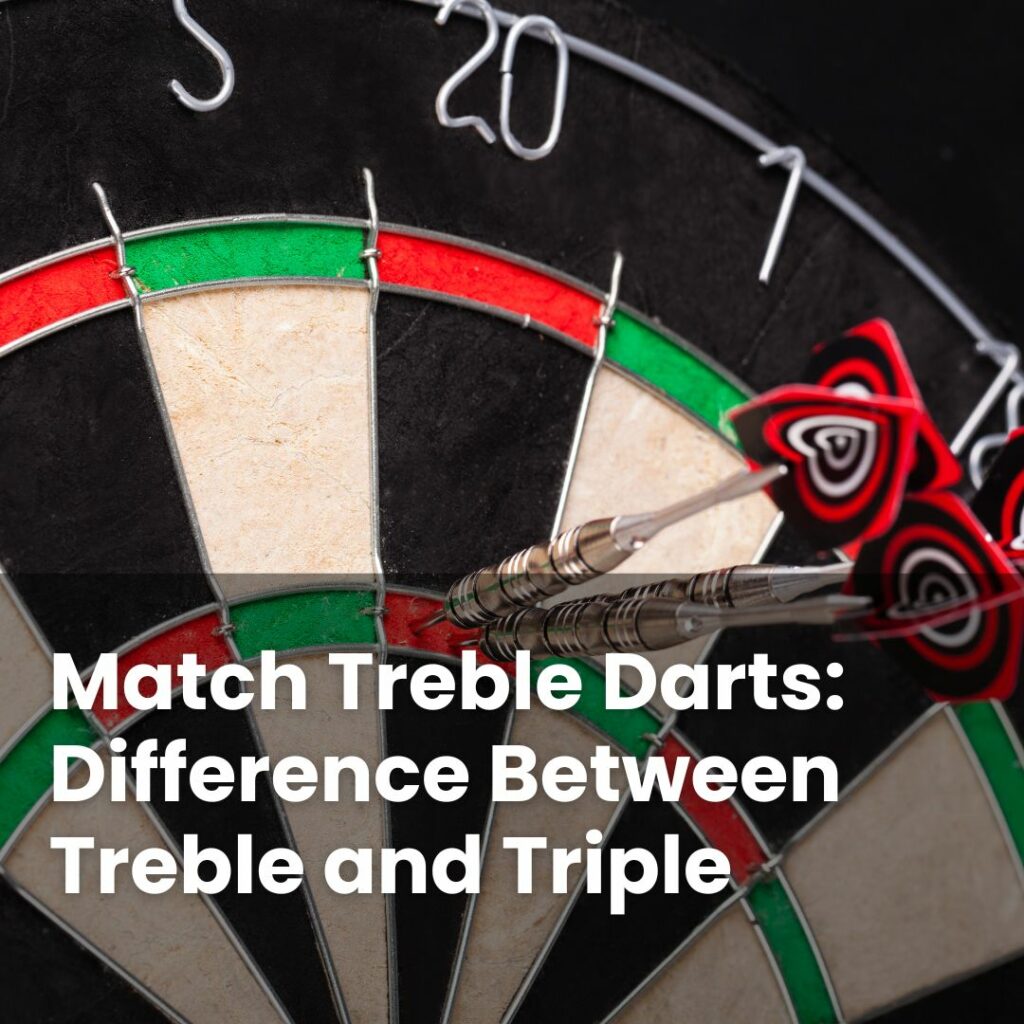
Now, we may define things more plainly. “Treble” is the official darts term for the narrow inner scoring ring located between the two single-score segments. Striking this section gives a boosted score on that number. You will see it shown on graphics and scoreboards with shorthand such as “T20” or “T19”.
Meanwhile, “triple” does not label any physical part of the board. People sometimes say it casually because the maths involves multiplying by three, yet it has no formal link to a specific ring. Only “treble” identifies that defined scoring band.
This clearer distinction is the source of many mix-ups heard during matches and commentary, especially for those still getting used to dartboard layouts.
Common Confusions Between Treble and Triple in Gameplay
The muddle usually begins with the arithmetic. New players notice the boosted score and instinctively say “triple”, even though the throw actually landed in the official treble section. In relaxed settings, this might slip by, but in proper scoring, it introduces uncertainty over whether the dart hit the ring or simply produced a tripled total in conversation.
Formal matches stay firmly with “treble”. Referees, graphics, and scorers use it consistently, and the notation supports this. A recorded “T20” tells everyone exactly where the dart landed, not just that the score increased.
With that terminology fixed, it becomes easier to appreciate how those precise hits influence the direction a leg develops.
Impact of Treble Hits on Match Strategy
Treble hits push scoring forward. Many throwers begin by aiming at the central high-value segment of the 20s area, as this produces rapid progress through a leg. If an early dart sits awkwardly and narrows the angle, shifting to the equivalent section in the 19s or 18s helps maintain momentum without forcing a cramped throw.
These hits also shape finishing routes. Certain totals pair neatly with particular doubles, and selecting the right treble earlier in the visit might leave a smoother end to the leg. For example, with 62 remaining, using the appropriate treble might lead to a preferable double, whereas landing in less helpful areas leaves tricky numbers. Classic finishes such as 170 rely heavily on well-judged treble choices along the way.
There is always a tension between aiming at powerful scoring zones and potentially drifting into areas that leave awkward totals. Skilled players adapt quickly, using alternative treble targets to recover a visit and arrange a number that suits their throwing style.
If you choose to place bets on darts, keep it occasional, set clear limits, and only stake amounts you are prepared to lose. If gambling affects your well-being or finances, reaching out early may help. GamCare and GambleAware provide free, confidential support.
Understanding that treble refers to a precise board segment—and that this ring shapes much of a leg’s flow—makes darts easier to follow, whether you are observing or imagining how you might approach the oche yourself.