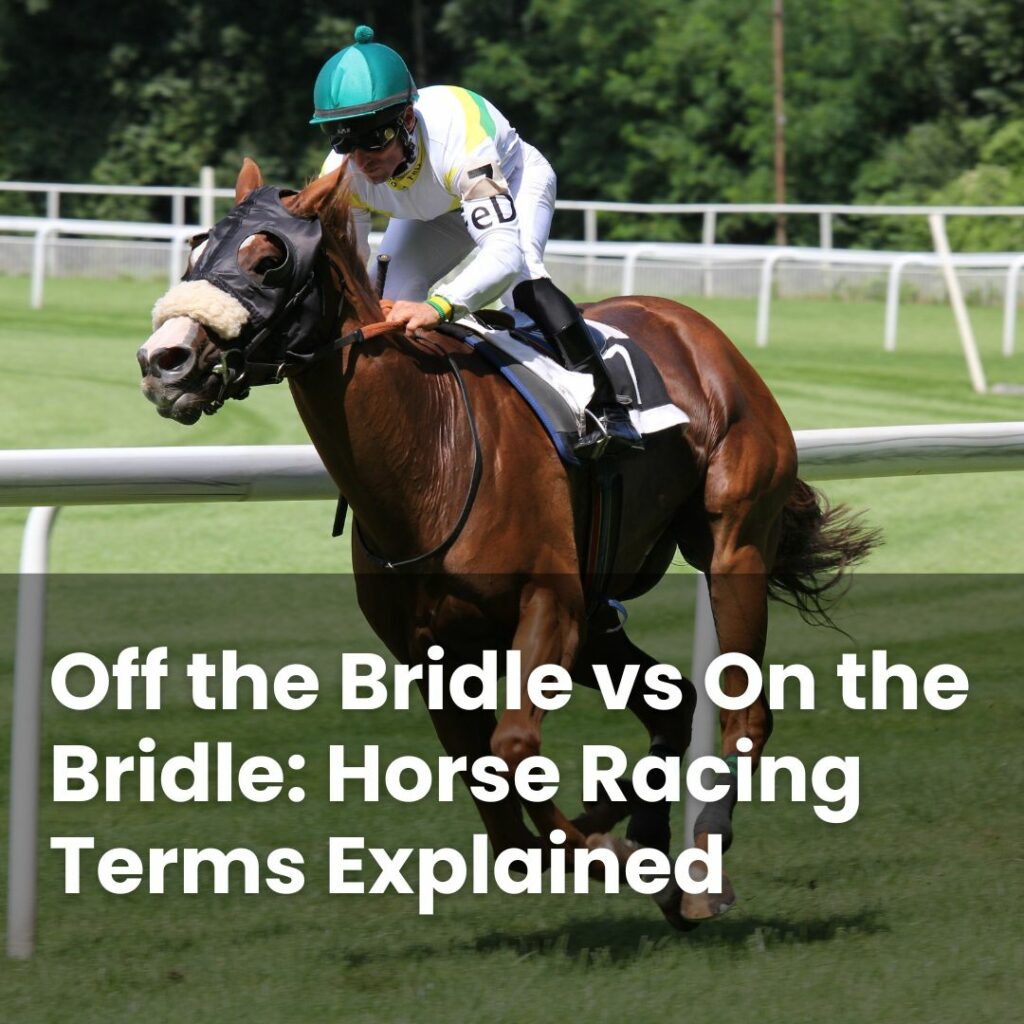
If you’ve heard people say a horse is “off the bridle” or “on the bridle” mid-race and wondered what on earth that means, you’re not alone. These phrases sound technical at first, but they describe something you can spot with a bit of practice.
Knowing the difference helps you read what’s happening in real time. You’ll see which horses are being asked for everything and which are still cruising, and that adds a layer of understanding to the action.
In this guide, we’ll explain both terms in plain English, show you how jockeys bring about these responses, and share what to look for on screen and in racecards.
What Does Off The Bridle Mean In Racing?
When a horse is “off the bridle,” the jockey has begun asking for maximum effort. You’ll see stronger riding, with the jockey pushing and using the reins more actively to keep the horse going. Where permitted and within the rules, the whip may be used as an aid to encouragement.
This stage usually appears late in the race when the pace lifts. The horse’s stride can start to look more laboured as it digs in under pressure. If others around it are still travelling smoothly, the contrast tells you plenty about how the race is taking shape.
In short, “off the bridle” signals that the easy part is over and the hard work has begun.
What Does On The Bridle Mean In Racing?
A horse “on the bridle” is moving comfortably without being pressed. The jockey sits still with quiet hands, keeping the reins soft while the horse carries itself. You’ll often see the horse maintaining position, or even improving, without any obvious effort being asked for.
Horses on the bridle look balanced and in control, saving that extra gear for later. It’s the mirror image of being off the bridle and hints that there could be more to come when the jockey finally asks the question.
So how do riders create these contrasting responses during a race? It starts with the bridle itself.
See Our Top-Rated Online Casinos
Find the best online casino bonuses, read reviews from real players & discover brand new casinos with our list of recommended sites
How Do Jockeys Use The Bridle During A Race?
The bridle is the horse’s steering and communication kit. Through the reins and bit, tiny movements from the jockey translate into guidance on balance, direction and pace.
Early on, the focus is on settling. A good settle stops a horse wasting energy, which makes it far easier to travel on the bridle. Through the middle of a race, subtle changes in hand pressure and body position help the horse maintain rhythm, hold a line through bends and respond to small tactical shifts.
As the finish approaches, the rider’s signals grow clearer. Stronger pushing, hands-and-heels riding and more assertive rein use ask the horse to quicken. Within the rules, the whip can be used to reinforce those cues. The best jockeys judge this perfectly, asking at the right moment so the horse can respond all the way to the line.
With that in mind, it becomes much easier to spot when a runner is being pushed or is still cruising.
Signs A Horse Is Running Off The Bridle
Once you know what to look for, the signs are quite clear. The jockey turns visibly busier, driving with the body and arms rather than sitting quiet. You might see the horse’s head lift or nod, the stride shorten, or a slight drift off a straight line as it works to respond.
There can be a clear change in momentum too. A horse that was holding its spot might start losing ground to rivals who still appear under restraint. The overall picture is one of graft: more movement from the rider, more effort from the horse, and less fluency than earlier.
Spot these patterns and you’ll recognise a runner that is being kept to its task rather than one that is travelling within itself.
Signs A Horse Is Running On The Bridle
The opposite picture looks smooth and contained. The jockey sits still, hands low and steady, guiding rather than driving. The horse’s action is even and economical, often edging closer to the leaders without being asked for a full effort.
You may notice a steady head carriage, a straight line of travel and a sense that the horse is waiting for the cue to go. That restraint is usually deliberate, keeping something in reserve for the final push.
How Do Track Conditions Affect Bridle Response?
Ground makes a big difference. On soft or heavy going, horses need more energy to maintain speed, so many will come off the bridle sooner. You’ll often see shorter strides and riders getting to work earlier.
On good or firmer surfaces, the same horse might travel far more sweetly, staying on the bridle for longer because the surface offers less resistance. Some horses act better on testing ground, others on quick ground, and that preference shows up in how long they can cruise before being asked for more.
These patterns often feed into how form is discussed and assessed.
How Does Off The Bridle Versus On The Bridle Affect Form And Betting?
Comments about travelling on or off the bridle add context to a horse’s form. Phrases like “cruised into it” or “hard ridden from halfway” indicate how comfortably a horse handled the race set-up. A runner that regularly stays on the bridle deep into its races may be coping well with pace and distance, while one driven early might be stretched by conditions or trip.
Used sensibly, these observations help shape expectations for next time, alongside other factors such as draw, pace maps, ground and fitness. They are not a guarantee of performance, but they do add colour to the bare result.
How Do Trainers Prepare Horses To Run On The Bridle?
It starts with conditioning. Trainers build a base of stamina and speed on gallops so a horse can hold a rhythm without strain. That fitness underpins the ability to travel on the bridle rather than needing to be driven from an early stage.
Schooling then sharpens the response to light cues. Horses learn to relax, follow a steady tempo and switch on when asked. Working in company helps them handle the cut and thrust of a race without getting lit up.
Stable routines complete the picture. Balanced feed, soundness checks and a calm environment allow a horse to arrive at the track composed and ready to use its energy efficiently. When all of that comes together, a horse is far more likely to travel sweetly and finish off when asked.
Much of that groundwork shows up later in how a horse is described in race reports.
How To Read Racecards And Commentary For Bridle Clues
Racecards and post-race comments often squeeze helpful cues into a few words. Notes such as “travelled strongly,” “pulled double,” or “hard held” point to a horse on the bridle. Mentions of “ridden along,” “off the bridle early,” “driven,” or “under pressure” flag the opposite.
Live commentary echoes this language. Phrases like “yet to be asked a question” tell you the jockey is still sitting still, while “pushed out” or “finding little” signal a runner under the pump. Taken together, these snippets help you see which horses conserve energy and which need plenty of urging.
On our racecards, you’ll often find these comments brought together so you can scan them quickly before a race. Once you tune in to the on-the-bridle and off-the-bridle cues, races become easier to read and a lot more enjoyable to follow from start to finish.