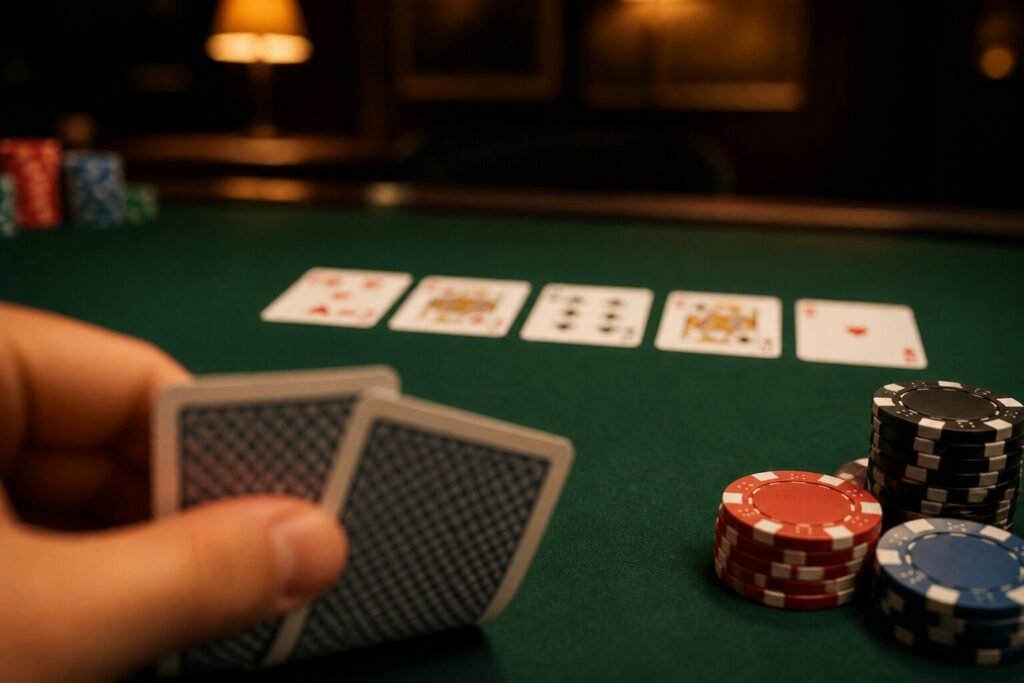
Ever wondered how the action at a poker table can shift so quickly? It comes down to the cards you hold and the ones shown in the centre of the table — once you understand how they interact, the choices you make become much clearer.
If you’re new to poker or simply brushing up on fundamentals, telling hole cards and community cards apart is essential. That distinction underpins how hands develop and how experienced players evaluate their options.
This article breaks those ideas down, shows what the flop does to the running hand, and gives practical pointers for reading the board so you can play with more confidence.
What Are Hole Cards in Poker?
Hole cards are the private cards dealt face down to each player at the start of a hand. In Texas Hold’em you get two; in Omaha you receive four. These are the cards only you can see and they form the personal portion of any five-card combination you might make.
How you view and value your hole cards shapes every decision at the table. They establish the hand’s potential before any community cards appear, and they determine the kinds of hands you can realistically aim for once the board is revealed.
If you want to try different formats, remember that the number of hole cards and the rules about using them vary between poker types, so the starting strategy also changes with the game.
What Are Community Cards and How Are They Used?
Community cards are dealt face up in the centre of the table and can be used by every player to build a hand. In Texas Hold’em, five community cards appear in stages; players combine those with their hole cards to make the best five-card hand possible.
Because everyone shares the same community cards, what sets hands apart is how each player’s private cards interact with the board. Reading that interaction is where much of the skill in poker lies.
These shared cards are visible to all from the moment they’re dealt, and that shared information is what turns a speculative pre-flop decision into a clearer tactical choice after the flop.
See Our Top-Rated Online Casinos
Find the best online casino bonuses, read reviews from real players & discover brand new casinos with our list of recommended sites
The Key Differences Between Hole Cards and Community Cards
The primary difference is visibility: hole cards are private, community cards are public. That simple distinction creates two layers of information at the table — personal knowledge and shared knowledge — and managing both is central to strong play.
Functionally, hole cards provide the starting point for your strategy; community cards change the landscape as they appear, offering new ways to make a winning hand or signalling danger when they favour other combinations. How common or rare certain board textures are will influence betting and defensive choices across a hand.
Knowing which role each card type plays helps you judge when to be aggressive, when to protect a hand, and when to step away.
How Does the Flop Work in Poker?
The flop refers to the three community cards dealt face up after the first round of betting. Once they’re on the table, they become shared elements that everyone can use with their hole cards, and a fresh round of betting follows.
This stage reveals a lot: it may improve some players’ hands, create potential draws for straights or flushes, or render certain hole-card combinations far less competitive. Players reassess and decide how much to commit based on how their private cards now combine with the board.
Because the flop dramatically reshapes the hand, reading it well is a major part of skilled poker play.
Why Is the Flop Important in Poker?
The flop is often the turning point of a hand. It transforms abstract pre-flop judgments into concrete situations where you can see real patterns, possibilities and risks. At this point you’ll gauge whether your hand has developed into something strong, whether it has drawing potential, or whether it’s largely behind other visible combinations.
Beyond the cards themselves, the flop affects the psychology around the table. Betting patterns change, and players reveal more about their likely holdings through how they react. That behavioural information, combined with the cards, guides subsequent decisions.
Understanding the flop is therefore about more than card combinations — it’s also about reading the evolving picture and adjusting your approach to protect value or limit losses.
Common Myths About Hole Cards and Community Cards
A few misconceptions persist among new players. One is that certain hole-card pairings somehow guarantee outcomes; in fact, every deal is independent and should be assessed on its current merits rather than past results. Another is the notion that community cards can be influenced; in regulated play, dealing follows strict procedures to prevent manipulation, and the board is revealed openly.
Some think that simply watching opponents will reveal their hole cards. While behaviour can offer clues, hole cards remain private until a player voluntarily shows them or a showdown occurs. Good players combine visible actions with board texture and probability to form a rounded judgement, rather than relying on any single tell.
Clearing up these myths helps you focus on useful information: the cards on the table, how they connect to your private cards, and how opponents behave in response.
How to Read the Flop for Beginners
Reading the flop starts with a calm, logical scan of the three community cards to see how they connect to your hole cards and to the kinds of hands other players might have. Take a moment to visualise plausible five-card combinations and how likely they are given what you hold.
Start by Seeing What Matches
First, check whether the flop pairs your hole cards or gives you draws to straights or flushes. For example, if you hold two hearts and the flop shows two hearts, you have a flush draw; if the flop pairs one of your hole cards, you may now hold a pair or two pair possibilities.
Notice What’s Possible for Others
Then, consider the board from the table’s perspective. Are there sequences that make straights? Is the texture such that a single overcard or paired board could favour an opponent who started with certain hole cards? Think about the most likely hands others could have based on what they’ve shown through betting and position.
Keep Play Responsible
Maintain sensible limits and treat play as a recreational pastime. Set a budget before you join a game and avoid chasing losses. If you need help, take breaks and consult support resources offered by reputable operators.
With these ideas in mind, reading the flop becomes a matter of combining card knowledge with observation. The more hands you watch and think through in this way, the better you’ll become at judging what the board is really offering — and when it’s time to continue or to fold.