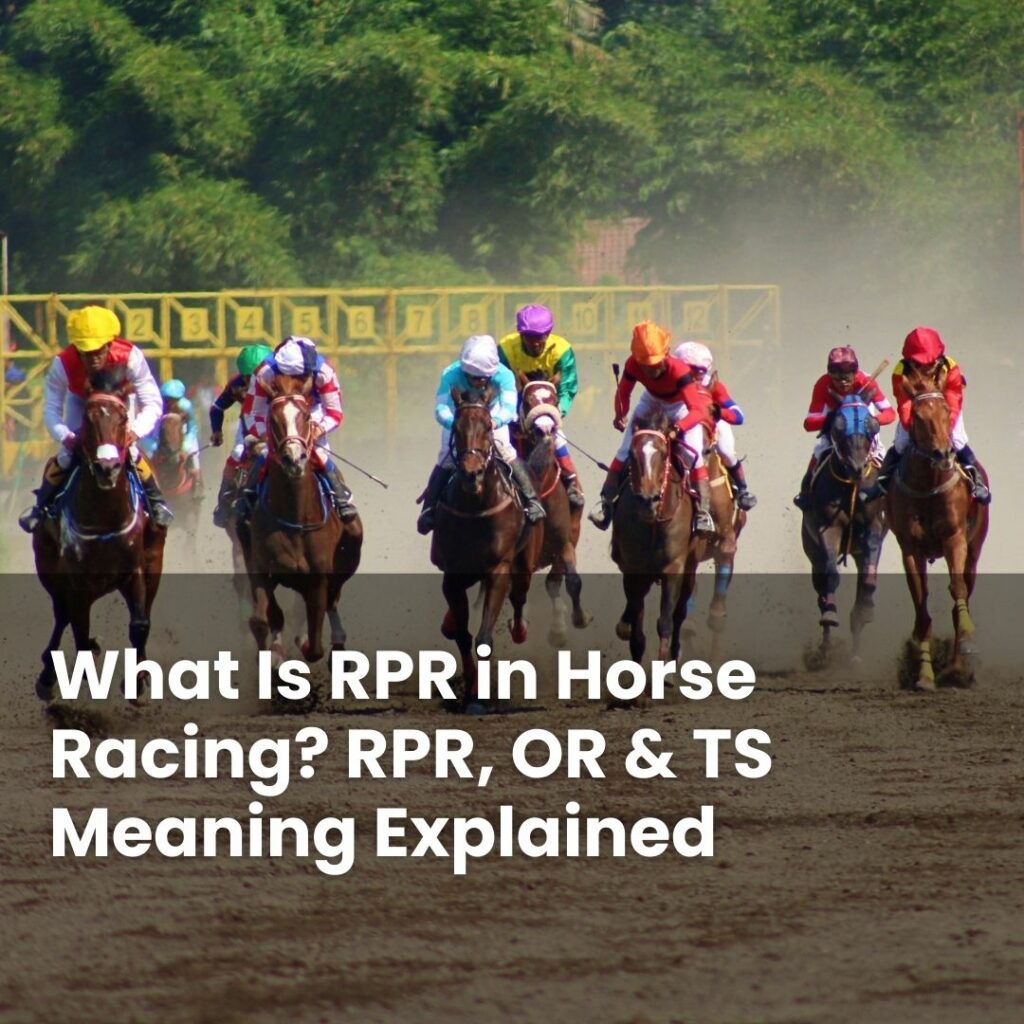
Horse racing racecards can feel busy at first glance, especially when they are packed with ratings and numbers for every runner. Terms like RPR, OR, and TS appear often, and understanding what they represent makes it much easier to follow form.
This blog explains what RPR, OR, and TS stand for, how they are produced, how they differ, and where to find them on a racecard. You will also see how these figures are used, when they are most helpful, and where they can be misunderstood.
Ratings are a guide, not a promise of any result. If you choose to bet, set sensible limits and keep it within your means.
What Is RPR And Who Produces It?
RPR stands for Racing Post Rating. It is a number created to reflect how well a horse performed in a specific race, with a higher figure indicating a stronger performance in that run.
These ratings are produced by the Racing Post. Their analysts apply their own methods, separate from official handicapping, to give each performance a figure after every race. They consider the level of opposition, the weight carried, the finishing position, and the margin involved.
Because RPRs are applied race by race, they make it easier to compare a horse’s runs across different tracks and conditions. For example, a horse might earn an RPR of 104 when winning a strong handicap on soft ground, which can be compared with a 98 earned in defeat on quicker going. The figures are opinion-based and method-led, but they give a consistent framework for judging the merit of a run.
With RPRs in mind, it helps to see how the official yardstick works alongside them.
What Does OR Mean In Horse Racing?
OR stands for Official Rating. It is the number assigned by the British Horseracing Authority to reflect a horse’s assessed ability.
The higher the OR, the more a horse has shown so far in its races. In handicaps, the OR is used to set the weight a horse carries, which aims to bring runners to a level playing field. A horse rated 100 will carry more weight than one rated 90, so the lower-rated horse is given a chance to compete on more equal terms.
Official Ratings are reviewed on a regular cycle and will rise or fall with recent performances. A clear win against solid opposition can bring a rise, while a below-par effort might see a small drop, particularly if it fits a pattern rather than being an obvious one-off.
Speed tells a slightly different story again, which is where TS comes in.
See Our Top-Rated Online Casinos
Find the best online casino bonuses, read reviews from real players & discover brand new casinos with our list of recommended sites
What Does TS Mean And When Is It Used?
TS stands for Topspeed. It is a measure of how fast a horse ran compared with what would be considered a standard time for the course and distance on the day.
Topspeed is calculated by the Racing Post using official race times. The process adjusts for distance, track layout, and conditions, often called the going allowance. A slow overall time on heavy ground can still earn a good TS if it is fast in context, while a quick clocking on firm ground may not rate highly if the day was generally quick.
TS is most useful for those who place value on race times and pace. It can highlight a runner that achieved a strong time figure in a truly run race, or flag when a steadily run event dampened the clock. Used alongside RPR and OR, it adds another angle to the form picture.
How Is RPR Calculated?
The Racing Post Rating is built from the merit of a horse’s performance, then adjusted for context. The exact formula is not published, but the approach blends race result data with expert interpretation to reach a final figure for that specific run.
Key Factors That Influence An RPR
Core inputs include finishing position, the strength of the opposition, and the weight carried. Margins matter, too, since a comfortable win against reliable rivals tends to rate higher than a narrow success in a weaker field. Beaten horses still receive an RPR, scaled from the winner’s figure using the distances between them and the quality of the race.
An RPR is not meant to stand alone as a single truth. It is a consistent way to express the merit of a run so that different races can be compared without reworking every detail from scratch.
How Course, Distance And Ground Are Adjusted In RPR
Track configuration, race distance, and ground conditions influence how hard a performance was to achieve. A stiff finish or an undulating track can test stamina, while tight turns may favour handier types. RPRs account for these factors so that a tough win at a demanding track is not treated the same as an easy success on a sharp circuit.
By adjusting for conditions, RPRs aim to provide a more neutral measure of form. That way, a horse posting a similar RPR under different circumstances has probably run to a comparable level, even if the race unfolded in a different style.
How To Read RPR, OR And TS On A Racecard
Racecards usually display RPR, OR, and TS in columns beside each runner. They offer a quick snapshot, but they are most useful when read together with the rest of the form.
RPR is shown as a number reflecting the merit of a recent or best performance. OR is the official handicap mark, a whole number used to set weights in handicaps. TS is the time-based rating from the Racing Post, again shown as a number.
In practical terms, a runner might have an OR of 92, a recent RPR of 98, and a TS of 85. That could suggest recent form a little above its official mark, with a time figure that was fair rather than outstanding, which may reflect the pace or the ground that day. The numbers are designed for comparison, so changes and patterns are often more useful than any single figure.
Understanding what the ratings say is one thing; putting them to work is another.
How Should Punters Use RPRs To Assess Form?
RPRs help build a picture of how a horse tends to perform. They can show whether a recent peak was a one-off, whether a horse is steadily improving, or whether it usually runs to a similar level under certain conditions.
Because RPRs are tied to individual runs, they are handy for spotting context. A sequence of figures around the same level suggests consistency. A recent spike might point to better placement, a change of trip, or a rise in fitness. When a runner returns to a track or ground that matches a previous high RPR, that echo can be informative without needing to restate the full calculation.
When To Rely On RPRs
RPRs are most persuasive when several recent runs tell the same story. They are also useful when comparing form lines from different meetings, or when a horse moves between distances and the figures already show it stays or travels well at the new trip. Matching RPRs with OR and TS can sharpen the view, for instance, when a horse runs a high RPR in a truly run race that also produced a solid TS.
When RPRs Can Be Misleading
Not every race sets up cleanly for ratings. A muddling pace can compress the field, which may flatter some and mask others. Small fields can turn tactical, wide trips can be costly at tight tracks, and heavy ground can stretch stamina so that finishing positions tell only part of the story. Horses changing stables, returning from a long break, or tackling a new surface can also outrun or underperform their past figures.
Used with judgement, RPRs provide structure to what you are seeing, but the race itself still matters.
Why Do RPR And Official Ratings Sometimes Differ?
RPR and OR are built for different roles, so differences are normal. The Racing Post produces an RPR for each performance using its own standards, while the BHA handicappers set an OR to balance the weights in handicaps and to reflect a horse’s overall level.
RPRs can react quickly to one run if the team believes the performance was notably better or worse than before. Official Ratings are updated on a schedule and often weigh a body of evidence rather than a single spike. Each approach has a purpose, which is why the two numbers might not match at any given moment.
Neither figure is a prediction; they are tools that describe performance in different ways.
How Does RPR Change After A Race And What Does That Tell You?
After every race, the Racing Post team reassesses the winner and the placed horses in the context of the opposition. A novice who beats older handicappers convincingly might earn a clear rise, while a short-head defeat in a stronger grade can still bring an uplift if the form looks solid.
Shifts in RPR help indicate whether a horse is trending up, holding its level, or dipping. A rising series across several starts often points to a horse finding its conditions or improving with experience. A drop can be the result of deeper company, an unsuitable pace, or an off day, which is why the pattern matters more than one isolated figure.
Common Misconceptions About RPR, OR And TS
It is a common misunderstanding that ratings identify the winner in advance. They do not. They are best used to compare what has happened and to frame what might be reasonable under similar conditions.
Higher numbers are not a guarantee either. A top-rating horse can be undone by a tactical race, a draw that works against it, or ground that blunts its strengths. Another misconception is that the three ratings are produced in the same way. They are not; RPR, OR, and TS each use different data and serve different purposes.
Ratings also change. They are updated with new evidence, but sometimes that process takes time, particularly for official marks that reflect the broader picture rather than a single run.
If gambling starts to affect your well-being or your finances, seek support early. Organisations such as GamCare and GambleAware provide free, confidential help. Used sensibly, ratings are there to inform your view, not to decide it for you.