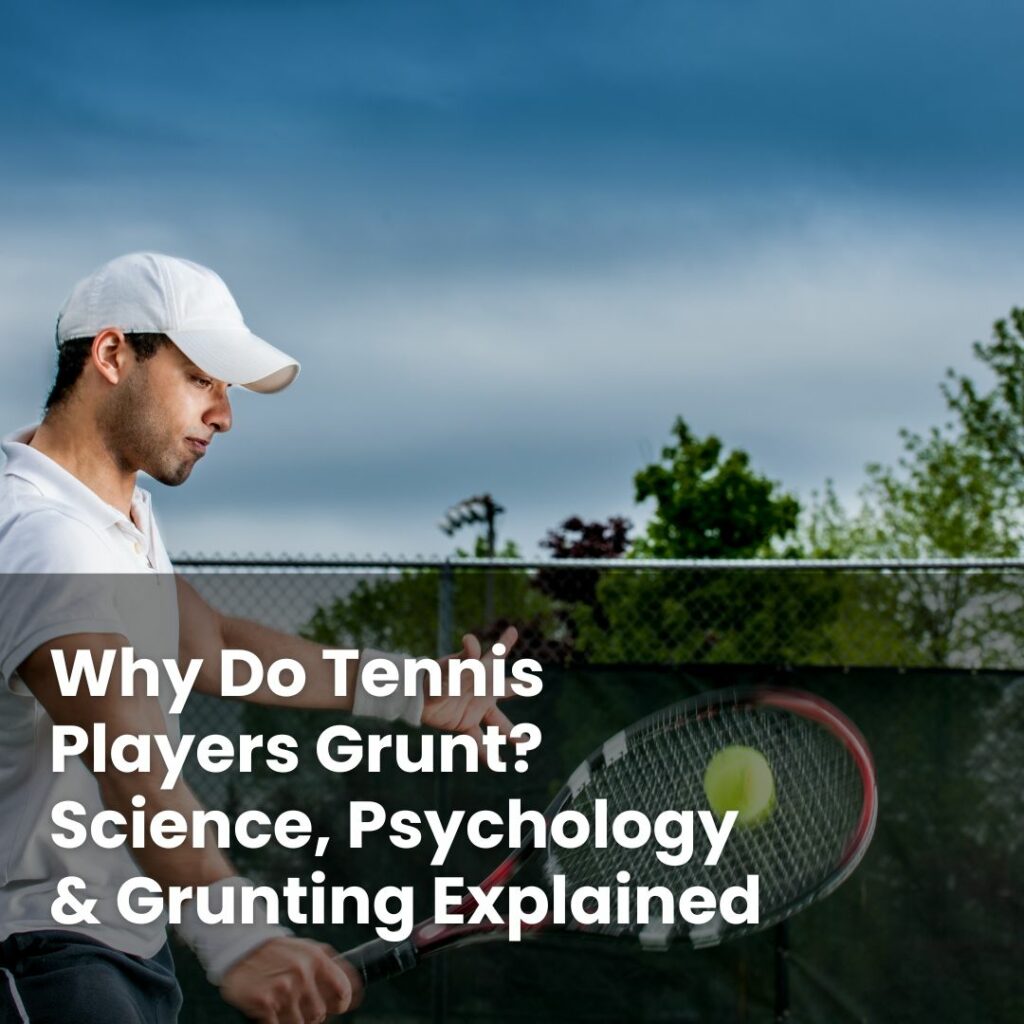
Grunting is a familiar sound on tennis courts, yet its purpose and impact are still argued by fans, players and officials. Some find it distracting, others see it as part of the modern game. Whether you are watching a major tournament or a local match, those sharp exhales and vocal bursts raise plenty of questions.
This article looks at why players grunt, what the science says about performance, whether it affects opponents, and how the rules approach it. It also explores coaching views, vocal health considerations, and how players, rivals and spectators respond.
Read on to explore the science, psychology and controversies surrounding grunting in tennis.
Why Do Players Grunt During Shots?
Grunting is noticeable at many levels of play, particularly in professional matches. The sound often happens as the ball is struck, and while it can be a personal habit, there are clear reasons behind it. The sections below break down the main factors.
Biomechanics: Breath, Core Tension And Power
Tennis demands full-body effort, with power travelling from the legs through the core to the racquet. A short, forceful exhale at impact can help a player brace the core, stabilise posture and release muscular tension. The sound that follows, whether a grunt or a sharp hiss, is often a by-product of that breath, not an aim in itself.
This kind of breathing mirrors what is seen in many sports, such as a controlled exhale during a heavy lift. By coordinating breath with movement, players can produce a cleaner transfer of force, especially on high-intensity strokes like serves and forehands. In that sense, the noise can be a sign of effort and technique working together rather than a deliberate tactic.
Rhythm And Motor Coordination
For some players, grunting becomes part of their timing. Linking a sound to the hitting action can help anchor rhythm so that footwork, swing and breathing stay in sync under pressure.
This coupling of sound and movement may support consistency when rallies speed up. It is comparable to athletes who use a brief exhale to cue the key moment of a sprint start or a throw. While not essential for everyone, it can be a useful cue for those who have built it into their routine.
So, does any of this show up when researchers measure it?
Does Research Show Grunting Improves Performance?
Several studies have tested whether grunting meaningfully affects performance, looking at shot speed, power and how others perceive the action. In controlled settings, some participants produced slightly faster or more forceful shots when asked to grunt or exhale forcefully compared with staying silent. This has been linked to breath control and muscle recruitment at the moment of impact.
That said, the gains are generally small and vary from player to player. For some, grunting makes no measurable difference; for others, it supports focus and shot rhythm. The effect seems most relevant on high-effort strokes, where breath and core engagement already play a bigger role.
It is also clear that noise alone does not decide outcomes. Results depend on a broad mix of skills, from technique and footwork to decision-making and conditioning. If you do bet on tennis, remember that no single habit determines a result, and only stake what you can afford.
There is another dimension to consider: how the sound affects the person on the other side of the net.
See Our Top-Rated Online Casinos
Find the best online casino bonuses, read reviews from real players & discover brand new casinos with our list of recommended sites
Does Grunting Distract Opponents Or Affect Their Timing?
Some players and coaches argue that loud grunting can interfere with an opponent’s focus. The strike of the ball provides useful information about speed and spin, and a sudden sound at impact may mask that cue. Research has shown that abrupt noises can delay reaction time or make shot prediction more difficult, though the effect is not uniform. Some players report disruption; others adapt quickly.
Importantly, distraction is not the same as a guaranteed advantage. Many professionals train to filter out noise and rely on visual cues like ball trajectory and racquet face. Still, when rallies are fast and margins are tight, any interference with timing can feel significant to the player trying to read the shot.
Are Grunts Allowed Under Tennis Rules And Umpire Guidance?
Grunting is not specifically banned in professional tennis. Officials allow players to make sounds during play unless it creates an unfair disturbance. Umpires can intervene if they judge the noise to be excessively loud or deliberately disruptive, and in rare instances, they may issue a warning or call a hindrance if the sound directly affects play.
There is no formal decibel limit, so much depends on the official’s judgement on the day. That case-by-case approach means enforcement can differ between matches and tournaments.
That grey area helps explain why the topic continues to stir debate.
What Are The Main Controversies And Complaints About Grunting?
The most common complaint is that loud grunting could disturb an opponent during a rally, masking the sound of contact and affecting timing. Spectators also raise concerns, especially during long exchanges where high-volume grunts dominate the audio of a match broadcast or the atmosphere in a stadium.
Another point of friction is intent. Some argue that grunting may cross into unsportsmanlike behaviour if it is used to unsettle an opponent, though proving that someone is doing it deliberately is difficult. As a result, calls for stricter guidance surface from time to time, but decisions largely remain with match officials.
Player Choices: Why Some Players Embrace Or Avoid Grunting
Players tend to develop their own routines through years of training. For some, grunting feels natural and helpful. It can reinforce breathing patterns, maintain rhythm and serve as a cue for effort at impact. Others prefer to play quietly, believing silence helps their concentration or simply reflecting the way they were coached early on.
Culture and coaching traditions play a role, too. Certain academies emphasise controlled breathing without sound, while others focus on the underlying mechanics and are indifferent to noise as long as technique and timing hold up. Across generations, attitudes vary: some grew up watching and emulating vocal players, others trained in quieter environments.
Style choices aside, there is also a health question to consider.
Physical Risks And Vocal Health Concerns
Vocal cords are muscles and tissue that can be strained by repeated, forceful sounds. Players who grunt frequently may experience hoarseness, soreness or vocal fatigue, particularly during periods of heavy training or back-to-back matches. In more persistent cases, rest or specialist assessment may be needed.
Coaches and medical staff often encourage players to manage breath control in ways that support performance without overloading the voice. Warm-ups that include light vocal and breathing drills, attention to hydration, and monitoring for throat irritation can help. Where grunting is part of a player’s routine, moderating volume and avoiding throat-tightening can reduce strain while preserving the benefits of a well-timed exhale.
How Should Coaches And Trainers Address Grunting In Practice?
In training, coaches focus on the foundations: efficient technique, balanced movement and effective breathing. When grunting appears, they consider whether it serves those aims or has simply become habit. If it helps timing and core engagement without straining the voice, it may be left alone. If it grows louder or starts to affect comfort, coaches can guide players towards quieter, controlled exhales that achieve the same mechanical outcome.
Sportsmanship is also part of the discussion. Most coaches underline that sounds should never be used to unsettle an opponent. Framing it this way helps young players understand that performance cues are fine, but they sit within the spirit of fair play.
Of course, not everyone making or hearing the noise is on the practice court. What about those who face it in matches or sit courtside?
How Can Opponents And Spectators Deal With Distracting Grunts?
Opponents who find grunting disruptive often learn to shift focus to visual information: the ball’s flight, the racquet path and the opponent’s body position. Many also lean on mental skills developed in noisy environments, such as steady breathing and reset routines between points. While ear protection is not allowed in professional play, training with background noise can make match-day sounds feel less intrusive.
Spectators have a few practical options. At live events, choosing seats further from the court or using discreet earplugs can soften the intensity of sound. Viewers at home can adjust audio settings when necessary, then return to full sound for commentary and on-court atmosphere.
If you bet on tennis, keep it occasional and within your means. Set personal limits that suit your circumstances, and seek support early if betting starts to affect your well-being or finances. Independent organisations such as GamCare and GambleAware offer free, confidential help.
Grunting will likely remain part of tennis, sometimes helpful, sometimes contentious. Understanding what it does for breath, rhythm and perception makes the noise easier to place in the bigger picture: a complex, high-speed sport where small details can shape how the game feels, even when they do not decide the score.