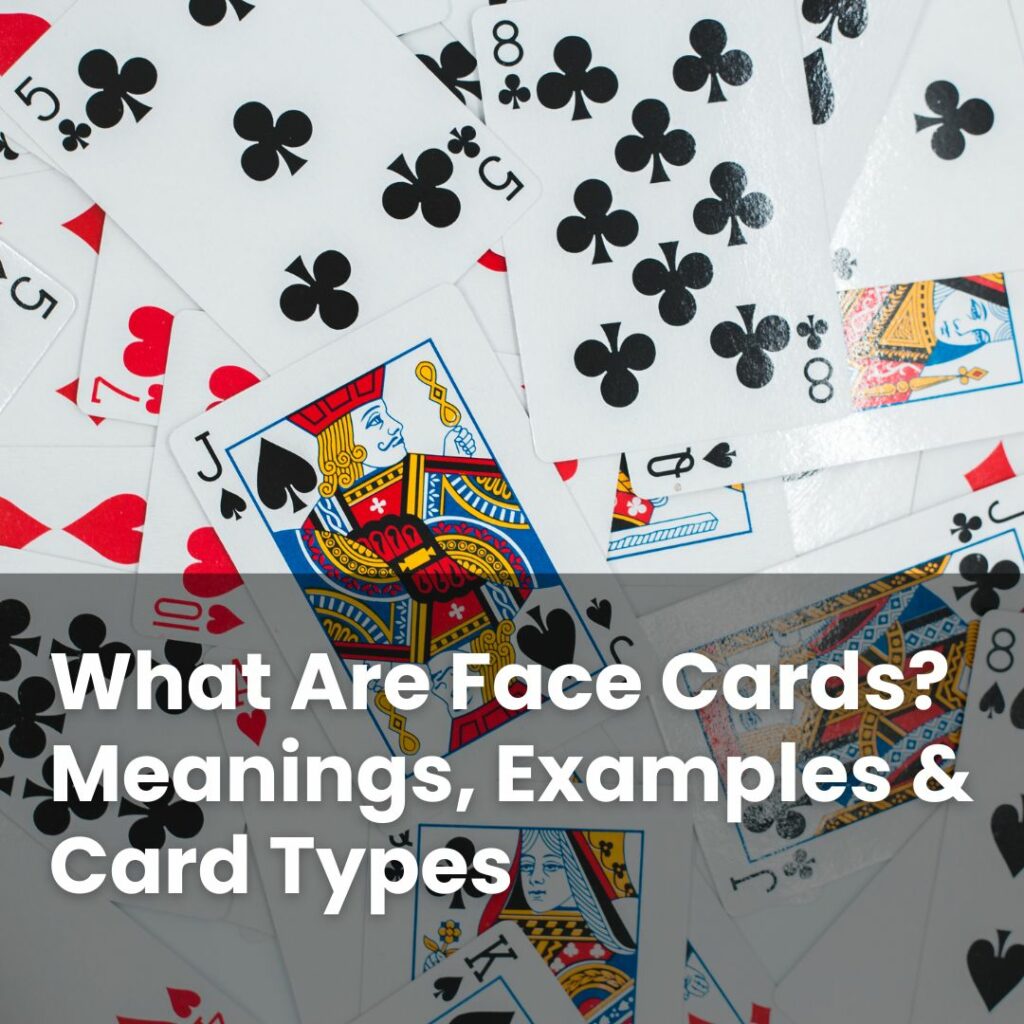
Face cards appear in a wide range of card games, from classic favourites to modern casino variations. While they may seem straightforward at first glance, there is more to these illustrated cards than meets the eye. Understanding them may enhance your knowledge of card games, casino play, and the symbolic meanings within a standard deck.
This post explains what counts as a face card, how they are used in different games, and their place within a deck. Whether you are playing for leisure or refreshing your knowledge, the information is presented clearly, moving from general concepts to more detailed explanations.
Read on to learn more about face cards and their role in card games.
What Does A Face Card Mean In A Deck?
In simple terms, a face card is a card that shows a person instead of a number or repeating symbols. They’re sometimes called court cards because they depict royal or court figures, a name that reflects their historical roots.
Typically, a standard deck has a few cards in each suit that are considered “special” in this way. They are easily recognised by their artwork, which differs from the numbered cards. The Ace, despite its prominence in many games, does not count as a face card because it lacks a personified image.
Face cards sometimes have particular significance in games—they may carry points, rank higher than numbers, or hold symbolic meanings. Looking more closely at each type may help you understand their roles.
Which Cards Are Considered Face Cards?
Face cards occupy a unique spot in a deck. Unlike the numbered cards, they feature human figures and are generally treated differently in most games.
Jack, Queen, And King Explained
The face cards in a standard deck are the Jack, Queen, and King. Each suit—hearts, diamonds, clubs, and spades—contains one of each, giving twelve face cards in total. While these cards all depict people, their rank and appearance vary:
- Jack: Usually the lowest of the three. Historically, the Jack represents a young courtier or attendant. Some decks depict “one-eyed” Jacks in profile, but this is mainly decorative and does not usually alter gameplay.
- Queen: Typically ranks above the Jack. She often represents a female noble or royal, sometimes holding symbolic items such as flowers or scepters. Her artistic depiction has shifted over centuries, but her position in ranking remains consistent.
- King: Generally the highest-ranking face card in standard play, often shown as a mature, regal figure. While certain games allow the Ace to outrank the King, the King is traditionally the most senior of the face cards.
Recognising these ranks may help in following scoring, hand composition, and decision-making if you choose to play.
See Our Top-Rated Online Casinos
Find the best online casino bonuses, read reviews from real players & discover brand new casinos with our list of recommended sites
How Are Face Cards Used In Casino Games?
Face cards might function differently depending on the type of game. Here are some examples of their roles:
- Blackjack:
- In blackjack, face cards are usually counted as 10 points.
- A combination of an Ace and any face card may add up to 21, often called a natural blackjack.
- Players making decisions about drawing another card might find the frequency of high-value cards important in their considerations.
- Baccarat:
- In baccarat, the cards showing people are often treated differently from numbered cards—they do not add to the total in the usual way.
- Only the final digit of the hand total counts. For instance, a 7 with a Queen would still be scored as 7, so the emphasis is on the overall hand rather than individual cards.
- Poker:
- Face cards generally rank Jack < Queen < King. They may form pairs, straights, three-of-a-kinds, full houses, or act as tie-breakers.
- Suits are usually secondary, except in specific cases like flushes or certain variants of poker.
- Other Games:
- In European or Asian card games, face cards might have entirely different roles, affecting scoring or hand value.
Checking rules before playing can help clarify how these cards operate, helping make the game flow more smoothly, minimising confusion, and allowing you to consider your moves more effectively.
Do Face Cards Have Special Values In Slots Or Table Games?
In slot machines, face cards usually act as symbols rather than representing numerical values. They are often grouped with Aces and 10s as “royal” symbols, although not every slot includes them, and the specific symbols can differ between games.
For instance:
- Kings might offer higher potential payouts than Queens.
- Symbols may appear stacked across the reels.
- They might trigger bonus features or free spins, depending on the game’s design.
It’s worth remembering that outcomes in slots are determined by random number software, so the traditional ranking or frequency of face cards does not apply. Consulting the game’s paytable is the best way to understand how these symbols function.
Are There Different Types Of Face Cards Across Decks?
Most playing card decks follow the familiar format of Jack, Queen, and King, but variations exist around the world.
- Spanish and Italian decks typically feature a King, Knight, and Knave, often without a Queen.
- German decks include King, Ober, and Unter, which translate to “Upper” and “Lower” officers.
- Tarot decks have four court cards per suit—King, Queen, Knight, and Page, with the Page functioning similarly to a Jack.
While the names and artwork may differ, all face cards generally depict human or court figures. Specialised or themed decks may introduce additional ranks or illustrations. Although Jokers are widely recognised, they are not considered face cards.
If using a non-standard deck, it is advisable to familiarise yourself with the specific rules of the game to understand how these cards are ranked and used.
Understanding face cards can enhance comprehension of games and strategies. When playing for money, it is important to set personal limits, take regular breaks, and avoid risking more than you can afford.
If gambling begins to impact your well-being, seeking support promptly is recommended. Organisations such as GamCare and GambleAware provide free, confidential assistance. Even learning the basics of how face cards function can make gameplay clearer and more enjoyable.
Face cards are more than decorative elements. From the youthful Jack to the regal King, each carries historical significance, symbolism, and practical value. Familiarity with these cards allows players to recognise them quickly, understand their role within a deck, and appreciate their place in both traditional and contemporary games.