Tennis can serve up some genuinely epic battles, with matches ranging from under an hour to, in rare cases, well over ten. That uncertainty is part of the drama and keeps fans watching.
From famous Wimbledon marathons to the usual match times on tour, the sport has produced some remarkable records. These extremes show just how demanding tennis can be.
If you’ve ever wondered what affects match duration, or which clashes truly pushed the limits, you’re in the right place. Here are the key facts, the records, and what makes certain contests unforgettable.
What Is the Average Length of a Tennis Match?
Most professional matches wrap up in a few hours. The long marathons make headlines, but they are outliers. Official timing runs from the first serve to the last point, so the pre-match warm-up does not count towards the duration.
Men’s Grand Slam matches, played as best of five sets, typically last around 2.5 to 3.5 hours. Straight-set wins often finish closer to two hours, while tight five-setters with a couple of tie-breaks can push well past four. Since the majors now use a 10-point tie-break in the deciding set, those never-ending final sets are far rarer than they used to be.
Women’s matches and men’s matches outside the Slams are usually best of three, coming in at roughly 1.5 to 2 hours. Routine victories can be done in around 90 minutes, whereas sets that reach 7-6 or feature lots of long deuce games will tilt towards the upper end of that range. Clay courts, with their slower conditions and longer rallies, can add minutes compared with quicker grass, with hard courts sitting somewhere in between.
Doubles is often shorter again, commonly finishing in 1 to 1.5 hours. On the regular tours, no-ad scoring and a 10-point match tie-break instead of a full third set help keep schedules moving. At the Slams the exact format can vary a little, but modern tie-break rules still rein in overly long finales.
Style of play, surface, and how closely matched the players are can nudge those numbers up or down. Big servers who hold quickly tend to shorten things, while baseline grinders who build points can lengthen them. Weather interruptions, roof closures and medical timeouts can extend the viewing window, even if suspended periods are not counted in the official match time.
So while the occasional clash stretches on, most matches finish in a sensible window that is easy to follow from start to finish, and planning for two to three hours will usually see you through.
What Factors Influence Match Duration?
Several elements shape how long a match lasts, and format is the big one. Best of five sets usually takes longer than best of three because there’s simply more tennis to play. Rules around tiebreaks and deciding sets matter too. Some events use a 10-point tiebreak, while others play out a full final set, which naturally takes longer.
Player styles matter. Big hitters and attacking players tend to keep points short, whereas counter-punchers and rally-focused players can extend exchanges and sets. High first-serve percentages or frequent net approaches can speed things up, while cautious second serves and lengthy return games do the opposite.
Surface plays a part, with faster courts generally shortening rallies and slower courts lengthening them. Conditions can also intervene. Heat, wind, and humidity influence tempo and energy levels, and rain or medical timeouts can add delays.
On top of that, the flow between points, challenges, and umpire decisions all add up. Taken together, these factors explain the gap between a brisk straight-sets win and a long, grinding battle.
See Our Top-Rated Online Casinos
Find the best online casino bonuses, read reviews from real players & discover brand new casinos with our list of recommended sites
Record-Breaking Tennis Matches Explained
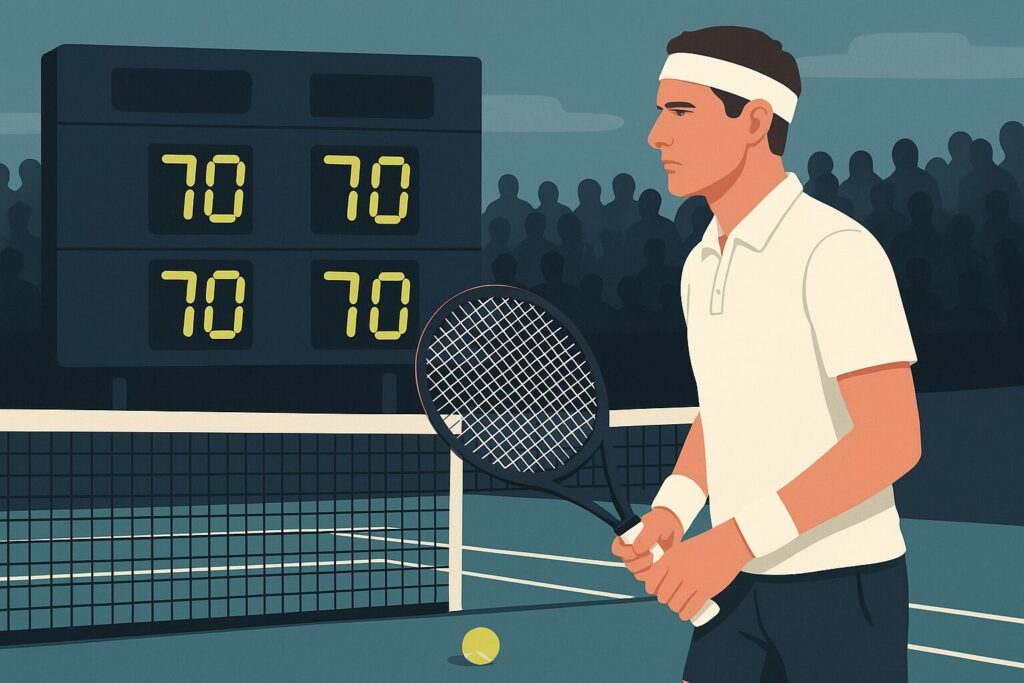
A handful of matches stand out for sheer length. The most famous is Wimbledon 2010, when John Isner beat Nicolas Mahut in a first-round contest that lasted 11 hours and 5 minutes across three days. The final set finished 70–68, a scoreline that cemented its place in history. Played on Court 18, it spanned 183 games.
Another milestone came at the 2004 French Open, where Fabrice Santoro edged Arnaud Clément over 6 hours and 33 minutes. It remains one of the longest encounters on clay at a major, with a 16–14 deciding set.
In women’s tennis, Vicki Nelson-Dunbar versus Jean Hepner in 1984 ran 6 hours and 31 minutes, featuring extraordinarily long rallies that tested concentration as much as fitness. One rally reached 643 shots during a tiebreak.
These matches are rare, and their demands helped drive rule changes at the top level to keep final sets from continuing indefinitely. The 2018 Anderson v Isner Wimbledon semi-final, 26–24 in the fifth, hastened the move to a deciding-set tiebreak. Since 2022 all four majors use a 10-point tiebreak at 6–6.
How Long Was the Longest Tennis Match Ever?
As noted above, the longest match took place at Wimbledon in 2010 between John Isner and Nicolas Mahut, played on Court 18. It lasted 11 hours and 5 minutes over three days, with a final score of 6–4, 3–6, 6–7(7), 7–6(3), 70–68 in Isner’s favour. The deciding set alone ran for more than eight hours, with play twice halted for fading light.
The pair played an unprecedented number of games, and the serving was relentless throughout. They contested 183 games in total and shared 216 aces, with Isner holding the single match record. Official records confirm this remains the longest match in professional tennis.
It was a rare moment when endurance, concentration, and match management were tested to the absolute limit, for players, officials and spectators alike.
Singles vs Doubles: Which Matches Last Longer?
Singles generally runs longer than doubles, especially at the majors where men play best of five sets. Two to four hours is common for singles at that level, and even women’s singles, played best of three, can nudge past the two-hour mark when rallies are lengthy and games reach deuce again and again. Baseline exchanges and tougher return games tend to build time on the clock.
Doubles is almost always best of three, and many events use a match tie-break to decide a third set, which keeps run-times in the 1 to 2 hour range. On regular tours, no-ad scoring is often used, trimming prolonged games. Quicker exchanges at the net and clear serving patterns help maintain pace, although serve-dominant pairs can push matches into successive tie-breaks that creep towards the two-hour mark.
Both formats offer something distinct: singles provides extended momentum swings and room for mid-match adjustments, while doubles brings rapid-fire teamwork, set plays and tighter timeframes. Actual duration still depends on surface, weather and player styles, so timings are best treated as approximate.
Why Are Some Matches Longer Than Others?
Evenly matched opponents often create longer contests. When both players hold serve consistently or trade long, tactical rallies, sets can stretch deep into tie-breaks. Tight deuce games can add plenty of minutes.
Serving and returning styles shape the clock too. Big servers can shorten points, but if neither player can break serve, sets extend. Defensive specialists and patient baseliners typically create longer exchanges.
Stoppages for treatment, equipment issues, or brief weather delays also add minutes. Ball changes also slow the restart. Put simply, when player strengths cancel each other out, time on court climbs.
Clay and best-of-five formats typically last longer than indoor hard and best-of-three.
Does Court Surface Affect Match Length?
Yes. Surface speed changes how points develop, how effective the serve is, and how much time players have to set up their shots. That shapes rally length and the number of deuces or tie-breaks you tend to see, which in turn influences total time on court.
Grass is the quickest underfoot. Balls skid and stay low, which can reduce rally length and bring matches to a faster close. Big servers and players who attack the net often thrive, leading to shorter points and fewer long return games. Sets can still stretch if serves dominate and tie-breaks are frequent, but the average contest is usually brisker. Conditions matter too, with a closed roof or a dry, lively court typically keeping things fast at Wimbledon.
Clay slows the ball and sends it higher, encouraging longer baseline exchanges and more grinding rallies. Service games are broken more often, games reach deuce more regularly, and the physical toll mounts. That often means more time on court, as seen at Roland-Garros. Weather plays a part as well, since cooler or damp conditions can make clay even slower, while heat and a lively ball can quicken it slightly.
Hard courts sit in the middle. They allow for a wide mix of tactics, so match length varies more with playing styles than with the surface itself. Pace can differ by event due to court materials, ball types and altitude, and indoor hard courts can feel a touch quicker. When aggressive players face counter-punchers, you might see extended rallies, whereas two first-strike players can keep points short even on a medium-speed court.
Format also matters alongside surface. Best-of-five contests naturally run longer than best-of-three, and tournaments with final-set tie-breaks can curb marathon finishes. Even so, the general pattern holds: grass tends to be shortest, clay the longest, and hard courts somewhere in between.
How Does Scoring Format Impact Match Duration?
Scoring rules heavily influence time. Best of five naturally runs longer than best of three. More sets also mean extra changeovers and sit-downs, so even brisk matches take longer overall.
Tiebreaks shorten sets that reach 6–6, preventing them from rolling on without a finish line. In doubles, many events decide the final set with a match tie-break to 10 points, which adds predictability. Many events also use no-ad scoring in doubles to keep things moving.
At the majors, final-set formats have been standardised. All four Grand Slams now use a 10-point tie-break at 6–6 in the deciding set, a change designed to avoid ultra-long finishes while keeping things competitive.
How Do Players Cope With Long Matches?
Preparation is everything. Pros build aerobic and strength bases so they can repeat high-intensity efforts for hours. Interval work, on-court drills and recovery sit within a periodised programme that tapers before big events.
Fuel and hydration matter just as much. Players arrive well hydrated, stick to familiar meals, and manage intake with fluids, electrolytes and easy-to-digest carbohydrates to maintain energy and concentration.
During play, regular sips and simple options like gels or bananas at changeovers keep blood sugar steady. In heat and humidity, extra salts and cooling towels help control body temperature.
Mental routines keep focus intact. Breathing patterns, set plays and between-point resets support composure, while sensible pacing, brief stretches at changeovers and swift treatment for niggles help stave off fatigue and keep decisions sharp.
Frequently Asked Questions on Tennis Match Length
How long does a typical tennis match last?
Singles matches usually last between 1.5 to 3 hours, depending on the number of sets and how competitive the players are. Doubles matches are often shorter, around 1 to 2 hours.
What’s the shortest possible professional match?
A straightforward straight-sets win can be wrapped up in under an hour, particularly if one player dominates or if a retirement occurs due to injury.
Do Grand Slam matches last longer?
Yes. Men’s Grand Slam matches are best of five sets and generally run longer than matches at other events, which are typically best of three.
Can weather affect match duration?
Absolutely. Rain can pause play, heat can slow the tempo, and wind can disrupt rhythm. Delays sometimes stretch matches over multiple days.
Does knowing match lengths help with betting?
Understanding match length is interesting for fans, but it does not predict outcomes or provide an advantage. If you choose to bet, set limits, use the safer gambling tools offered by licensed operators, and never stake more than you can afford to lose.