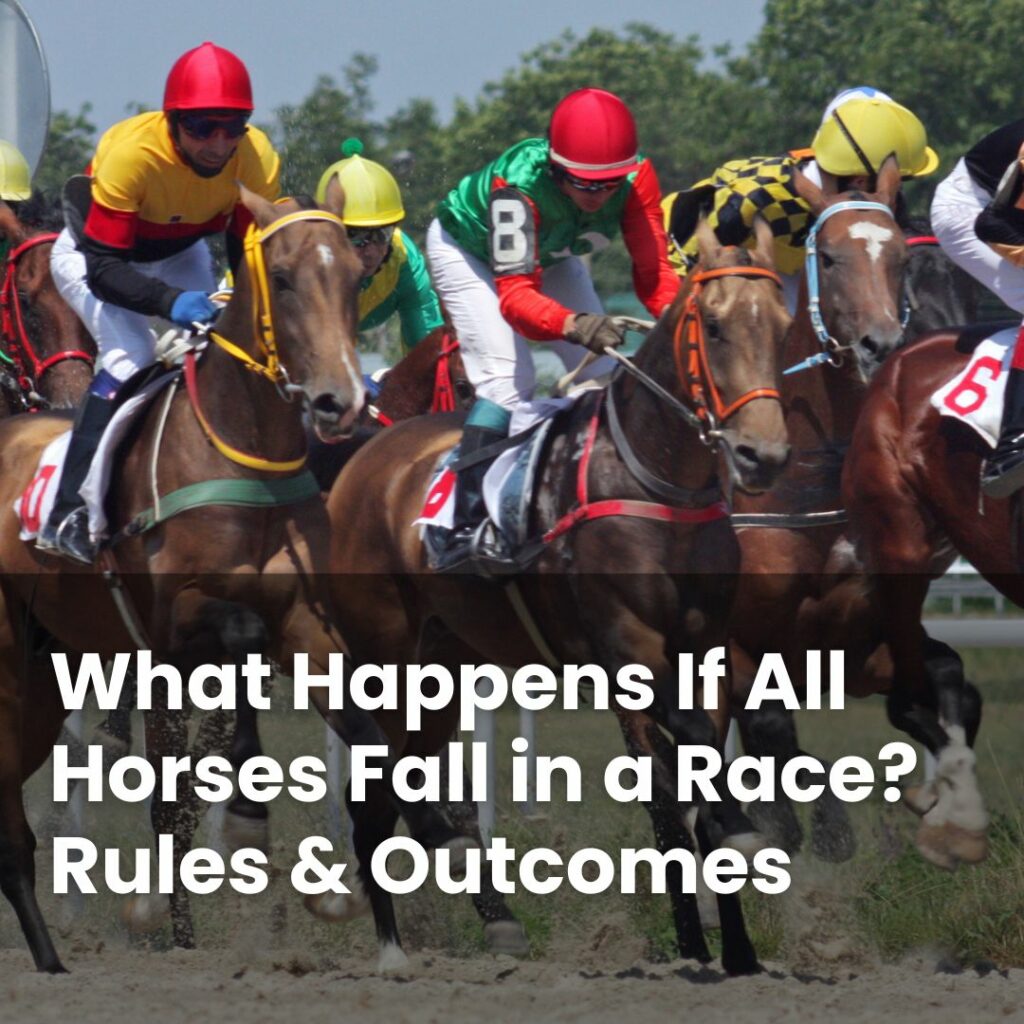
If you have ever watched a horse race, you will know how quickly things can change. Falls do happen, and on very rare occasions several runners can come down in the same race. But what if every horse does, and none of them finishes?
It is an unusual scenario, yet it matters for anyone who follows racing or has a bet on the day. The result affects records, settlements, and even the rest of the card.
Here is how the rules handle it, what that means for bets, and why the officials on course play such a key role. If you ever feel gambling is causing stress or worry, support is available at BeGambleAware.org.
What Are The Rules If All Horses Fall In A Race?
In UK racing, if every horse falls or cannot complete the course, the stewards step in. They are responsible for applying the rules and confirming the official result.
Their first task is to check whether any horse and rider can continue safely. Under modern safety protocols, remounting is tightly controlled and only permitted when officials are satisfied it is safe and within the rules. If it is not permitted, or no runner is able to complete the course, the race is normally declared void. For betting, that means it is treated as if it did not happen and stakes are usually returned.
If only one horse completes the race, that horse is the winner, regardless of how many rivals failed to finish. If none reaches the line, there is no winner, and the race is void.
For edge cases or clarifications, the British Horseracing Authority publishes the governing rules and updates that stewards follow on the day.
With the framework set, what outcomes can you actually see when many runners come down?
Possible Official Outcomes After A Mass Fall
When several or all runners fall, there are only a few ways a race can be settled under the rules.
The most common outcome is that the race is declared void. This happens when no horse is able to complete the course in a fair and safe manner.
There are situations where a jockey may continue and finish, but only if officials allow it and confirm that conditions are safe. If exactly one horse crosses the line, that horse is awarded the win, even if it finished a long way behind the pace the race was being run at.
On rare occasions, more than one horse may complete after an incident. In those cases, placings are decided in the usual way based on the finishing order.
Stewards review video, speak to participants, and confirm the result only when they are satisfied that safety and fairness have been upheld.
That decision feeds straight into what happens to your bet.
See Our Top-Rated Online Casinos
Find the best online casino bonuses, read reviews from real players & discover brand new casinos with our list of recommended sites
Do Bets Stand If All Horses Fall In A Race?
Win Bets
Win bets are simple, you are backing a horse to finish first. If the race is declared void because no runner finishes, the bet is not settled as a win or a loss. Most bookmakers refund the stake because there is no official result.
Place And Each-Way Bets
Place bets, and the place part of each-way bets, require your horse to finish within the designated places. If the race is wiped from the record as void, those parts are void too, and stakes are usually returned.
Forecasts And Tricasts
Forecasts need the first two in the correct order, while tricasts require the first three. If the event is made void, these have no valid outcome and are typically refunded.
Accumulators And Multiple Bets
If one leg of a multiple or accumulator is a race that becomes void, that selection is treated as a non-runner. The rest of the bet stands and is settled on the remaining legs at the adjusted odds.
How Do Bookmakers And The Tote Treat A Race With A Total Fall?
When no horse finishes and the race is declared void, most bookmakers refund stakes on all affected bets. Online, this is usually processed automatically. In shops, the slip can be taken back to the counter to collect a refund.
The Tote works a little differently because it is pool betting, but the outcome is similar in this scenario. If the race is void for official purposes, Tote pools for that race are refunded, since there are no valid winners to share the pool.
If anything looks unclear after an unusual incident, it is worth checking the rules published by your betting operator or contacting customer support for confirmation.
Of course, all of this depends on the decision that stewards reach on the day.
How Do Stewards Decide On Re-Running Or Letting A Result Stand?
Stewards are the appointed officials at every race meeting. When a mass fall or widespread non-completion occurs, they examine exactly what happened.
They review the going, weather, and the state of the obstacles, and consider whether any outside factor contributed. They also take evidence from jockeys, trainers, and course staff, then assess whether any horse completed the race in line with the rules.
If one or more runners finish properly and safety has not been compromised, they allow the result to stand. If no horse can complete in a fair and safe way, the race is generally made void.
On very rare occasions, if the incident was caused by something avoidable or external, they may consider ordering a re-run. Any such call takes into account the timetable for the meeting and, most importantly, welfare considerations.
What Happens To Jockeys And Horses After A Fall?
When a fall happens, welfare comes first. Every race meeting has medical teams for riders and veterinary teams for horses ready to respond immediately.
Jockeys are assessed by trained medics, and anyone showing signs of injury is stood down until cleared. Protocols for concussion and other trauma are strict, with on-course facilities used for checks before a rider can return.
Horses are examined by vets as soon as it is safe. Some only need a moment and can be led away. Others may require treatment on the track or transport for further care. Any decision about continuing in the race is taken only if both horse and rider are unharmed and officials confirm it is safe, which is why remounting is so tightly controlled.
Everything on the day is built around safety, sound medical advice, and the long-term care of horses and riders.
Once the on-course picture is clearer, attention turns to how bets are handled.
What Should Bettors Do If A Race Is Declared Void Or Re-Run?
If a race is declared void, your stake is usually refunded. Online accounts are credited automatically, while shop bets can be taken back to the counter. It is sensible to check your account history or keep hold of the receipt until the refund shows.
If a race is re-run, your original bet does not carry over. The void wipes the slate clean, so you would need to place a fresh bet if you want to take part in the re-run.
For multiples, a void race is treated as a non-runner. The other selections continue as normal, and your potential return adjusts to reflect the removed leg.
If anything remains unclear, your bookmaker’s rules or customer support team can explain how your specific bet has been settled.
How Will A Mass Fall Affect Future Betting Markets?
A void race can ripple into future markets. Bookmakers reassess odds for the horses and jockeys involved, especially if a runner might need time off or be rerouted to different targets. That can mean prices move and entries change, sometimes right up to declaration time.
Form guides will record the race as void or incomplete, which can make reading recent runs a little trickier. Trainers may alter plans to allow for recovery or schooling, and race programmes can be adjusted to replace lost contests, creating new markets along the way.
If you are looking ahead after an incident like this, it helps to keep an eye on official updates for entries, declarations, and any notes on a horse’s wellbeing.
If you feel gambling is starting to affect your daily life, help is available confidentially at BeGambleAware.org. Please only place bets if you are over 18.