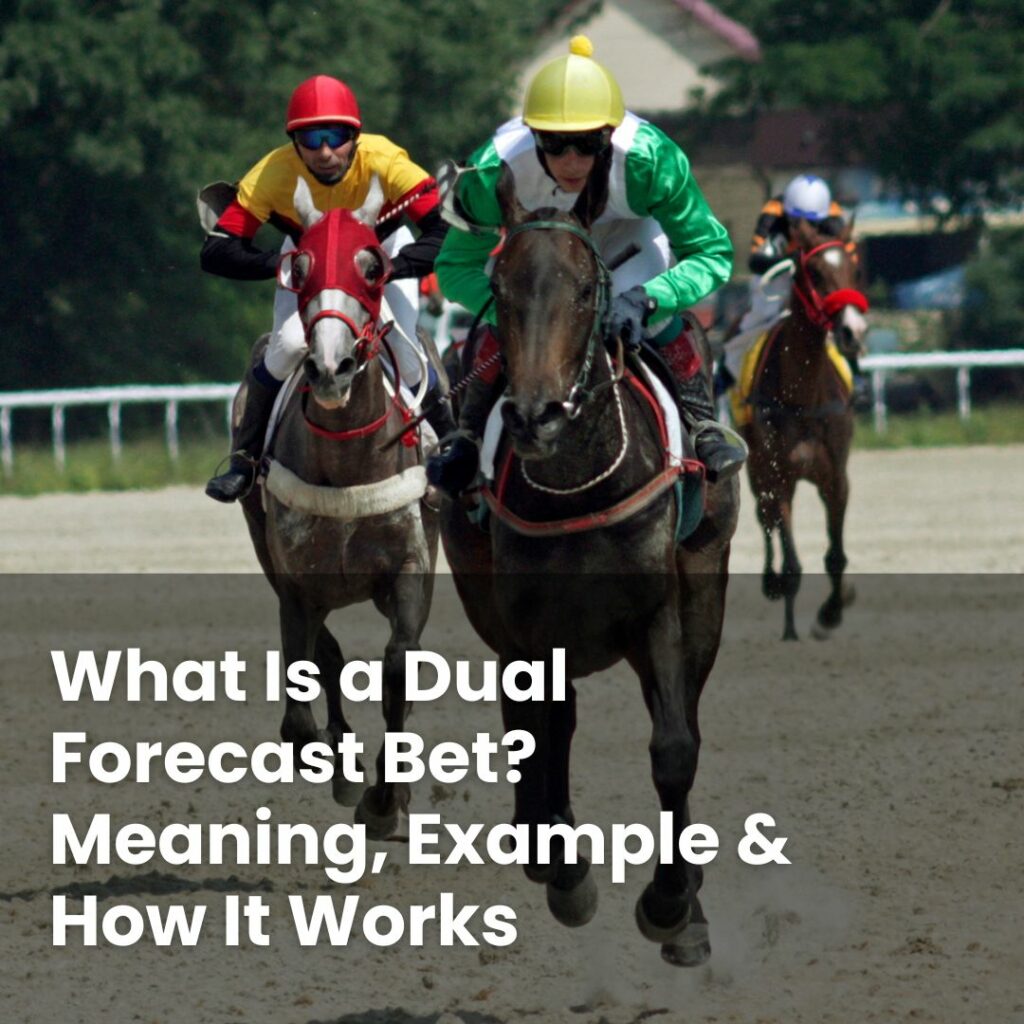
If you enjoy horse or greyhound racing and want a bet that focuses on the top two, a dual forecast offers a different angle from the usual win wager.
It can look a bit technical at first glance, but once you know what it means and how returns are worked out, it becomes straightforward to follow.
This blog post explains what a dual forecast is, gives clear examples, shows how payouts are calculated and how to place one, and highlights common mistakes to avoid. Keep stakes sensible and only bet what you can afford.
How Does A Dual Forecast Bet Work?
A dual forecast bet is used in races with several runners, typically horse or greyhound events. You pick two different runners that you think will fill the first two places, in any order.
For the bet to pay out, both selections must finish in the top two. The order does not matter, but if either finishes outside the first two, the bet loses.
Returns are worked out differently to a simple win bet. Because the outcome depends on two named runners filling the top two, the potential payout can be higher than backing just one winner, although it depends on the final odds.
Stakes are set when the bet is placed, and settlement happens once the result is official. Bookmakers usually offer dual forecasts only in races with at least three runners.
With the basics in place, the next step is understanding the rules that decide whether a dual forecast stands and how it is settled.
Dual Forecast Bet Rules And Winning Conditions
The core aim stays the same: your two selections must be the first and second home, in any order. Beyond that, a few rules shape how the bet is treated.
Dual forecasts are valid only in races with three or more participants. If a race cuts to fewer than three, forecast markets are typically void.
Dead heats can affect settlement. If two or more runners share a placing, most bookmakers split part of the return according to standard dead-heat rules, which can reduce the payout compared with a clear result.
If one of your selections is a non-runner, the bet is usually adjusted and settled as a single on the remaining runner, though exact treatment can vary. Always check the operator’s terms for the precise approach.
Now that the conditions are clear, it helps to see how a result turns into a return.
See Our Top-Rated Online Casinos
Find the best online casino bonuses, read reviews from real players & discover brand new casinos with our list of recommended sites
Example Of A Dual Forecast Bet With Odds And Payouts
Imagine a six-runner horse race. You choose Horse A and Horse B in a dual forecast to finish first and second in any order.
If Horse A wins and Horse B is second, or the other way around, the bet wins.
The payout uses the starting prices of both runners and the shape of the race. It is not a simple case of multiplying the two odds. Instead, an official figure is produced for the winning combination, often called the dual forecast dividend.
For instance, if the official dividend is £28.50 and your stake was £1, the return is £28.50. If the forecast loses, the stake is lost.
That official figure begs the question: how is it actually calculated?
How Are Winnings Calculated On A Dual Forecast?
In the UK, most horse and greyhound forecast bets are settled using the Computer Straight Forecast (CSF) or an official dividend. After the race, the winning first-and-second pairing is identified and a dividend is published that shows the return per £1 staked.
The calculation takes into account the starting prices of the two placed runners and the overall make-up of the field. It is designed to reflect how widely backed that exact pairing was, which is why you will not see the return match a simple odds multiplication.
If the dividend is £24.15, a £2 stake returns £48.30. Bookmakers display the dividend after the result, so you can see the exact return before collecting.
How Do I Place A Dual Forecast Bet With A Bookmaker?
Most online bookmakers and high street shops offer dual forecasts on eligible races. Choose a race with at least three declared runners, decide on the two entrants you think will fill the top two, and select the Forecast or Dual Forecast option on the betting slip. Enter the pair, set your stake, and confirm.
It is worth pausing to double-check the runner names and the stake before submitting, as bets are accepted at the amount shown and are not usually altered afterwards. Keeping a copy of your bet receipt or confirmation helps if you need to query settlement later.
If you like the concept but want to cover extra possibilities, the variations below give you more flexibility.
Variations: Reverse Forecast And Combination Forecasts
A reverse forecast covers both possible finishing orders of two chosen runners by placing two separate bets, one for each order. Because it is two bets, the total stake is doubled, but you are covered whether Runner A beats Runner B or the other way round.
A combination forecast broadens the net. Choose three or more runners and you place a separate forecast on every possible pair that could fill first and second in any order. This increases the number of ways to win, but it also increases the overall stake because each pairing is a separate bet. A quick check of how many combinations you are creating keeps the total cost clear.
When Is A Dual Forecast Better Than Other Bet Types?
A dual forecast can suit situations where two runners look notably stronger than the rest, but their exact finishing order feels uncertain. In a race with two standout favourites, it gives a focused way to back them both to dominate the finish without committing to who beats whom.
It can also be attractive when each runner on their own might be a short price to win. If both make the first two, a dual forecast often returns more than a single win bet on either one, though it still requires both to place in the top two, which is harder than backing one to place.
There are no guarantees with any bet type, so it helps to compare options, consider how confident you are about the front pair, and choose a stake that fits your limits.
Common Mistakes To Avoid With Dual Forecast Bets
A few avoidable errors crop up regularly. Keeping these in mind can make the experience smoother:
- Skipping the runner count. Dual forecasts need at least three runners; otherwise the market will not stand.
- Misunderstanding payouts. Returns are based on the official dividend, not the two odds multiplied together.
- Ignoring race context. Picking two favourites or two outsiders without looking at form, going, draw, or recent performance can weaken the bet.
- Rushing the slip. Typos in runner names or stake amounts are common and can be costly if not spotted before confirming.
- Overstaking. Forecasts can be appealing, but they should sit within a budget set aside for betting.
If you choose to place this type of bet, keep it within your means and treat it as occasional entertainment. If betting starts to affect your well-being or finances, seek support early. GamCare and GambleAware offer free, confidential help.